Outdoor Floral Hemp Research in Utah
Introduction
Highlights
- Cultivar choice and harvest timing were the strongest and most consistent drivers of biomass, CBD, CBG, THC, and marketable cannabinoid yield.
- A broader 3-year trial of 18 cultivars showed a maturity tradeoff: early bloomers often had higher floral allocation and CBD concentration but greater THC risk, while later bloomers often produced more vegetative biomass and lower cannabinoid concentration.
- Irrigation technologies (MESA, LESA, LEPA, and MDI) usually produced similar floral hemp yield and quality. Reducing irrigation often maintained biomass and improved water productivity.
- Additional N or P did not increase biomass or CBD yield in the 2020– 2022 fertility study at a relatively fertile site; very high default fertilizer rates were not justified.
- Cannabinoid instability occurs near maturity and cultivar rankings shifted among years. Use local, multiyear cultivar information and frequent, representative sampling as harvest approaches.
Floral hemp producers in the Intermountain West face numerous management decisions: which cultivar to plant, which irrigation system to use, and how much water and fertilizer to apply. Utah State University field research near Logan, Utah, from 2020 to 2022 evaluated these questions in outdoor, irrigated conditions.
These trials included:
- A broad cultivar trial that evaluated 18 commercially available cultivars across 2020–2022 to compare flowering timing, biomass, cannabinoid concentration, and cannabinoid yield (Table 1).
- Three floral hemp cultivars per year across four pivot/lateral irrigation technologies and four irrigation levels.
- A single floral hemp cultivar with nitrogen (N) and phosphorus (P) fertilizer rates.
Important notes about methods in all trials:
- Researchers transplanted all hemp cultivars by hand at 5-by-5-foot spacing in late May to Early June.
- No herbicide was registered for use in hemp at the time of the study. As this was research, we applied a single application of Sonalan® herbicide at rates used for safflower before or at the time of transplanting each year. Subsequent in-season weed control consisted of hand weeding.
- Researchers used no fungicides or pesticides during the trials and noted little to no pest or disease pressure.
Table 1. Summary of Three Outdoor Floral Hemp Trials in Utah
| Study | Years | Main comparisons | Hemp cultivars |
|---|---|---|---|
| Broader cultivar trial | 2020–2022 | 18 different cultivars in total, including 11 in 2020, 15 in 2021, and 6 in 2022 | Tokyo Plus, Trump, Abacus, Abacus Improved, Cherry Abacus, Double the Cherry, Berry Blossom, Dutch Delight, Double Dutch, Dutch Domination Dazzling Dutchess, The Wife, Knock Out, Suver Haze, BaOx, Royal North, Royal South, Royal Frosting |
| Cultivar + irrigation | 2020–2021 | Four irrigation technologies (MESA, LESA, LEPA, and MDI) and four irrigation levels (100, 75, 50, and 50% targeted) | Abacus, Tokyo Plus, and Trump (2020) or The Wife (2021) |
| Fertility | 2020–2022 | Nitrogen and phosphorus fertilizer rates, including high rates in 2020–2021, and a range of rates and a nonfertilized treatment in 2022 | Trump |
Table 2. Summary of Four Hemp Cultivars Evaluated in Outdoor Irrigation Trials in Utah
| Hemp cultivar | Relative maturity | What stood out in the Utah trials | Producer implication |
|---|---|---|---|
| Abacus | Early | High harvest index; highest 2021 CBD concentration (6.3%) and CBD yield (~304 lb/acre); THC stayed below the 0.3% regulation threshold in both years. | Earlier flowering can favor floral allocation and may reduce late-season water demand. |
| Tokyo Plus | Mid to late | Highest 2020 floral biomass and high CBD/CBG yield; THC exceeded 0.3% at all irrigation levels in 2020 but remained below the threshold in 2021. | High yield potential, but genetics and harvest timing require close THC monitoring. |
| Trump | Mid | Stable THC (about 0.20%–0.22%) across 2020 irrigation levels; 50% uniform irrigation produced ~1.43 tons/acre floral biomass, 20% more than full irrigation. Used in all fertility trials. | Relatively stable THC response in this study; fertility responses were limited. |
| The Wife | Late (2021 only) | Strong biomass under several irrigation systems; CBD yield ~242 lb/acre in 2021. Cannabinoids peaked before the chosen harvest date, suggesting harvest could have been about 1 week earlier. | Maturity labels may not predict local harvest timing; monitor the crop rather than relying only on calendar date. |
Notes. Cultivar performance should not be treated as a universal ranking. Cultivar availability changed between years, and weather, harvest timing, and plant-to-plant variability affected results.
Cultivar Selection: The Most Important Management Choice
Across both the irrigation trials and the broader 3-year cultivar trial, cultivar choice drove differences in floral biomass, stem biomass, harvest index (floral and leaf biomass ÷ total aboveground plant biomass), cannabidiol (CBD), cannabigerol (CBG), tetrahydrocannabinol (THC), and cannabinoid yield (CBD concentration × yield). Flowering time, driven by day length, strongly shaped biomass yield and cannabinoid accumulation, as hemp is photoperiod sensitive, meaning that the vegetative growth stops when flower initiation begins (Table 2). Thus, cultivar selection should be a combined genetics, maturity, harvest-timing, and compliance decision, not simply a choice based on advertised CBD percentage, as these percentages often reflect greenhouse conditions: controlled lighting, proper moisture, etc.
Cultivar Choice and THC Risk
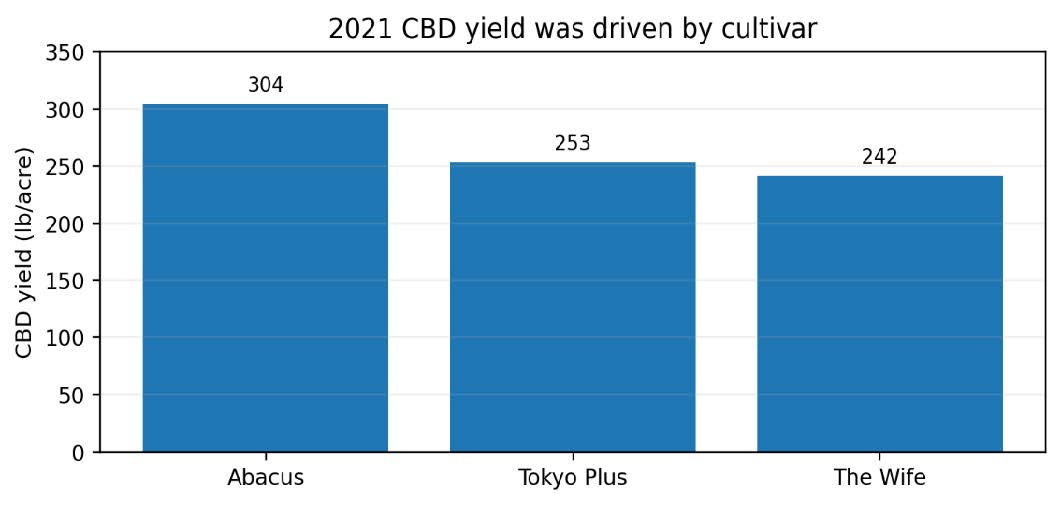
The irrigation study showed why cultivar selection and harvest timing are inseparable. Tokyo Plus exceeded the 0.3% total THC regulation threshold at every irrigation level in 2020 (0.32%–0.37%), while Abacus and Trump remained below it. This illustrates that the THC accumulation was driven by cultivar, not plant stress from lack of irrigation. In 2021, all cultivars remained below the threshold due to better harvest timing knowledge, and they produced between 242 and 304 lbs of CBD per acre (Figure 1). This year-to-year contrast indicates that genetics, environment, plant variability, and harvest timing can matter more than a single management input.
The Broader 3-Year Cultivar Trials
The Maturity Tradeoff
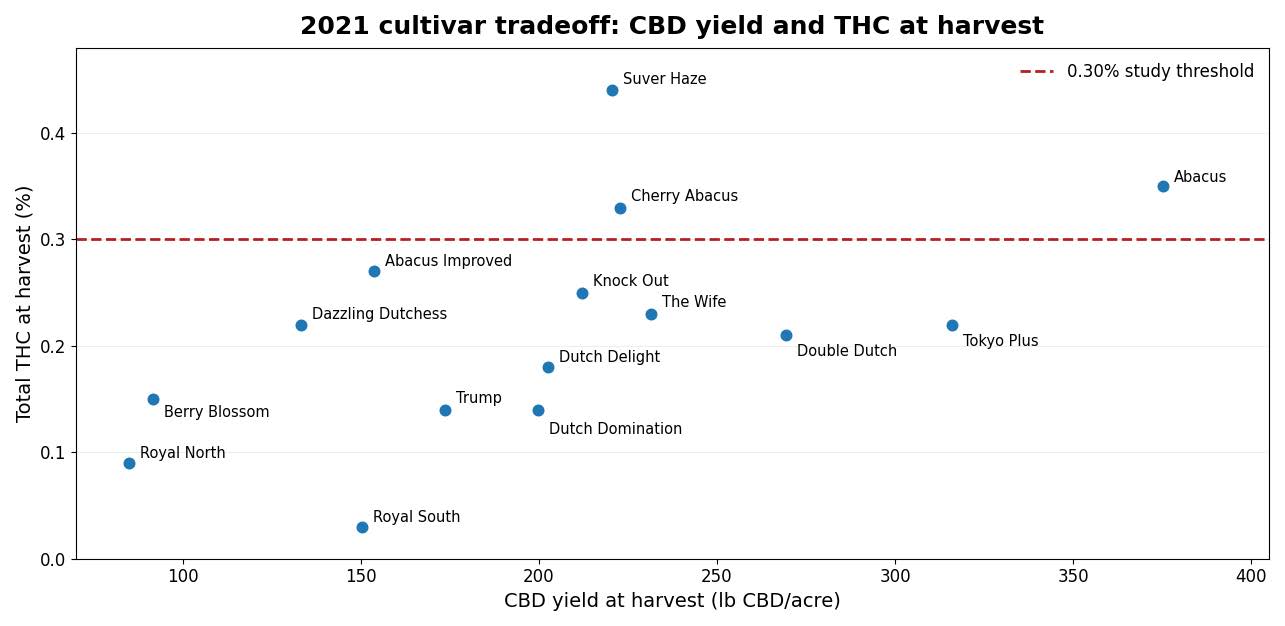
- Early bloomers often had high harvest index and high CBD concentration, but several approached or exceeded the THC threshold before or at selected harvest time.
- Mid-blooming cultivars often offered the best balance of biomass, cannabinoid yield, and a workable harvest window.
- Late bloomers often remained lower in THC but could run out of warm weather, irrigation availability, or frost-free days before cannabinoid accumulation was complete.
The cultivar-only study evaluated 11 cultivars in 2020, 15 in 2021, and six in 2022. Seventeen unique cultivars were represented, although availability varied by year due to supply (Table 3). The trial reinforced that floral initiation and maturity are central production traits. Among cultivars with reported values, flowering initiation ranged from about 13.5 to 15 hours of daylength. Earlier flowering stopped leaf and stem (little to no cannabinoids) production to focus on flowering (more cannabinoids), while later flowering generally prolonged vegetative growth, increasing stem and leaf production. This meant the earlier bloomers were more compact in height and width while mid and late bloomers grew tall and wide, thus more susceptible to late-season windstorms.
How Maturity Affected Performance
Table 3. Pattern, Strengths, Risks, and Examples of Hemp Cultivar Maturity in Utah Trials
| Maturity pattern | Typical strengths | Main risks | Examples from Utah cultivar trial |
|---|---|---|---|
| Early (~14.5–15 h) | Higher floral allocation and harvest index; often high CBD concentration. |
Faster THC accumulation; some low-biomass plants; harvest can arrive early. | Abacus types, Suver Haze, Royal North, Royal Frosting |
| Mid | Often balanced biomass and cannabinoid yield. | Still requires close THC monitoring; cultivar-to-cultivar differences remained large. | Berry Blossom, Trump, Double Dutch, Tokyo Plus |
| Late (~13.5–13.75 h) | More vegetative biomass; several cultivars remained comfortably below THC threshold. |
May not fully mature before frost or irrigation ends; lower CBD concentration can dilute value. |
Dutch Delight, Dutch Domination, Dazzling Dutchess, The Wife, Royal South |
Cultivars That Combined CBD Yield With THC Compliance
Table 4. Hemp Cultivar Biomass, Yield, and Cannabinoids in Utah Trials
| Cultivar | Years | Floral biomass (tons/acre) | CBD yield (lb/acre) | THC at harvest (%) | Producer interpretation |
|---|---|---|---|---|---|
| Berry Blossom | 2020–2021 | 1.37–1.44 | 92–121 | 0.15–0.21 | Moderate CBD yield with compliant harvest THC in both years. |
| Dutch Delight | 2020–2021 | 0.93–2.25 | 90–203 | 0.18–0.25 | Large year-to-year biomass response; remained below 0.30%. |
| Trump | 2020–2021 | 1.70–2.46 | 118–174 | 0.14–0.25 | Consistently compliant in the cultivar trial and relatively stable in the irrigation trial. |
| The Wife | 2021 | 2.11 | 231 | 0.23 | Strong 2021 CBD yield with compliant THC; only one cultivar-trial year. |
| Tokyo Plus | 2020–2021 | 1.99–3.36 | 265–316 | 0.22–0.39 | High biomass and CBD yield, but exceeded the THC threshold in 2020. |
Notes. Cultivar rankings changed among years. These values should be used as regional evidence, not guaranteed performance.
Harvest Timing, THC Risk, and Year-to-Year Variability
The 3-year cultivar trial showed that harvest timing can change a floral hemp crop’s value and legality within a short period (Table 4). Cannabinoid concentrations often rose rapidly after flower initiation, and some cultivars crossed the 0.30% THC threshold, as CBD was still increasing. In 2020, several later cultivars crossed or approached the threshold near 126 days after planting. In 2021, Abacus, Abacus Improved, and Cherry Abacus generally peaked in CBD and THC near 97 days after planting, indicating that waiting for a later calendar harvest could sacrifice compliance (Figure 2). Late-maturing cultivars in 2022 were still accumulating CBD when the northern Utah season was ending. Literature suggests floral hemp takes 6 to 8 weeks to mature, but based on the flower initiation and growing season, it can be more condensed or elongated in Utah.
What Producers Can Take From the Cultivar Trial
Cultivar and Harvest Checklist
- Buy genetics with documented outdoor flowering behavior in your region; cultivar names and commercial lines were not always consistent across suppliers.
- Record the date of first visible flowering for each cultivar and use that date and not a single farm-wide calendar date to plan sampling and harvest.
- Sample cannabinoids repeatedly as harvest approaches. Plant-to-plant and year-to-year variation was large enough that a single sample can give false confidence.
- Compare CBD or CBG pounds per acre, not concentration alone. A high percentage can be offset by low floral biomass—flowers produce more compounds than the leaves, but leaves are hard to separate out.
- For CBD-oriented production, Berry Blossom, Dutch Delight, Trump, and The Wife provided useful combinations of CBD yield and THC compliance in these trials.
- For CBG, Royal North, Royal South, and Dutch Domination were among the most promising while remaining below the THC threshold.
- Tokyo Plus was a good example of the yield vs. compliance tradeoff: it produced some of the greatest biomass and CBD yields but exceeded the 0.30% threshold in 2020 and would have been destroyed.
Influence of Irrigation Technologies
The study compared four irrigation technologies: mid-elevation spray application (MESA), low-elevation spray application (LESA), low-energy precision application (LEPA), and mobile drip irrigation (MDI). Over 2 years, technology effects on floral biomass and cannabinoids were minor and inconsistent; low-elevation or MDI systems did not consistently outperform the MESA grower standard (Table 5).
Table 5. Irrigation Technology Comparisons for Hemp Trials in Utah During 2020–2021
| Technology | Description | Takeaway |
|---|---|---|
| MESA | Mid-elevation spray; grower standard | Usually matched the other tested systems for biomass yield and cannabinoids. |
| LESA | Low-elevation spray | Occasional advantages, but no consistent overall benefit. |
| LEPA | Low-energy precision application | Some high cultivar-specific yields; no consistent advantage across years. |
| MDI | Mobile drip irrigation | Floral yield was often similar; stem or CBG yield was sometimes lower. |
Influence of Irrigation Levels
Because a hemp crop coefficient was unavailable, researchers based irrigation levels on estimated corn evapotranspiration (ET). Thus, 100% was a corn-based reference, not a demonstrated hemp water requirement. The other treatments were 75% and 50% of corn ET, applied as a uniform reduction at each irrigation. The 50% targeted reduction also received roughly half the irrigation of the 100% level, but the deficit was targeted to ensure critical growth stages of hemp received the most irrigation while limiting it at other times, such as toward the end of the season. However, this trial had three hemp cultivars with different flower initiation, so perfecting this scheduled reduction was difficult (Table 6).
Reduced irrigation rarely caused a consistent loss in floral biomass (Figure 3). Trump produced its greatest 2020 biomass under the 50% uniform rate, and Tokyo Plus was statistically similar at 100% and 50% uniform. The 50% uniform treatment also had the greatest irrigation productivity in both years, and the targeted 50% was not consistently better. These results suggest that floral hemp in Utah uses much less water than silage corn. However, more detailed studies are needed to determine hemp water requirements.
Table 6. Irrigation Levels for Hemp Cultivars in Utah Irrigation Trials in 2020–2021
| Irrigation treatment | 2020 | 2021 |
|---|---|---|
| 100% | 14.3 in. | 15.5 in. |
| 75% uniform | 10.7 in. | 11.6 in. |
| 50% uniform | 7.2 in. | 7.8 in. |
| 50% targeted | 8.4 in. | 9.3 in. |
Notes. Growing-season precipitation was about 4.3 inches in 2020 and 9.3 inches in 2021. Most 2021 precipitation arrived late or outside the main crop-use period.
Fertilizer: More Applied N and P Did Not Mean More Floral Hemp
The fertility study used Trump transplants from 2020 through 2022 (Table 7). In 2020 and 2021, baseline N rates were set using Utah State University silage corn guidelines because hemp-specific fertilizer guidelines were unavailable. Additional N or P was then applied to test claims that floral hemp requires unusually high fertility. In 2022, the study expanded to include several nitrogen (N) and phosphorus (P) fertilizer rates and a nonfertilized treatment. All years used ammonium nitrate (32-0-0) as the N source and triple superphosphate (0-46-0) as the P source. Applications were split: half the rate at transplanting and half at flower initiation.
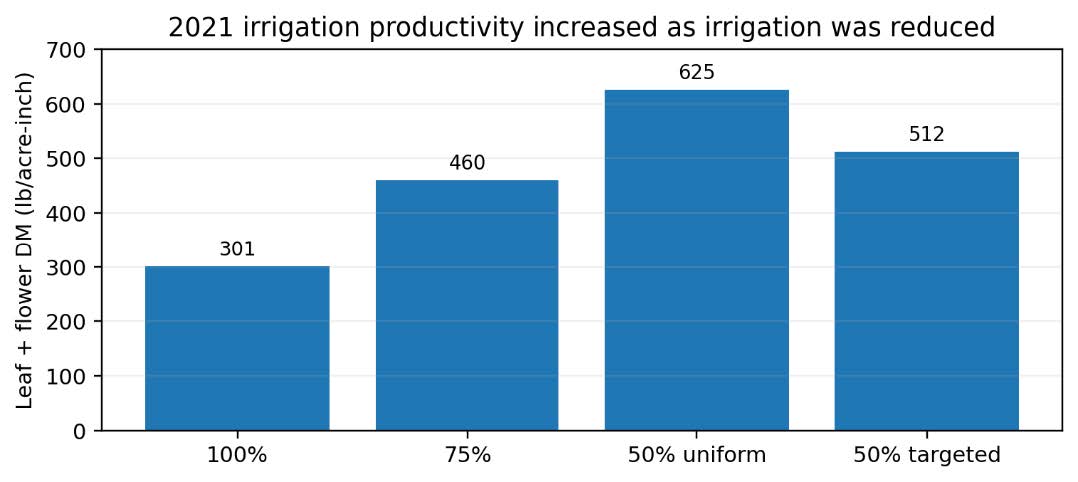
Note. The 50% uniform treatment produced the most leaf plus flower dry matter per acre-inch.
Data from Sullivan et al., 2025a
Table 7. Fertilizer Treatments and Results in Hemp Trials in Utah During 2020–2022
| Year | Fertilizer range tested (approx.) | Main result |
|---|---|---|
| 2020 | 100 lb N/acre baseline; +100 lb N/acre or +100 lb P2O5/acre | No increase in biomass, CBD yield, or harvest index from the extra N or P. |
| 2021 | 110 lb N/acre baseline; +100 lb N/acre or +100 lb P2O5/acre | No biomass or CBD yield benefit from the additional fertilizer. |
| 2022 | Separate N rates from 0 to 200 lb N/acre and P rates from 0 to 100 lb P2O5/acre, including a nonfertilized treatment | The nonfertilized treatment produced similar floral biomass and cannabinoid yield as the fertilized treatments. |
Across the study, N and P fertilizer rates had little effect on floral hemp productivity or cannabinoid yield. Leaf and flower biomass, stem biomass, harvest index, CBD concentration, and CBD or CBG yield per acre generally did not respond significantly to increasing fertilizer rates (Table 8). Although occasional year-specific differences occurred in THC concentration and plant tissue nutrient levels, these responses were inconsistent. Overall, applying high N or P rates did not reliably increase biomass or cannabinoid production and was not an effective strategy for managing THC concentration.
Table 8. Summary of Fertilizer Trial Results
| Outcome | Response to N or P | Producer interpretation |
|---|---|---|
| Leaf + flower biomass | No significant effect in any year | High fertilizer rates did not increase marketable biomass at this site. |
| Stem biomass/harvest index | No significant effect | Extra fertilizer did not change biomass allocation in a consistent way. |
| CBD concentration | No significant effect in 2020–2022 | High N or P was not a reliable strategy for increasing CBD percentage. |
| CBD or CBG yield per acre | No significant effect in any year | Fertilizer did not increase the amount of marketable cannabinoid produced per acre. |
| THC concentration | Occasional year-specific differences | Fertility was not a dependable tool for keeping THC below the regulation threshold. |
| Plant tissue nutrients | A few isolated differences | Most nutrient concentrations were not consistently changed by fertilizer treatment. |
Soil Testing Matters More Than a Default Rate
Soil test P at the site ranged from 20 to 26 ppm, above the roughly 15 ppm critical level commonly used for many Utah crops. Additional P never increased hemp tissue P, and it did not increase biomass or CBD yield. These results do not mean hemp never needs fertilizer; rather, applying large rates where soil fertility is already adequate can add cost without increasing production.
For N, researchers measured soil nitrate each year and adjusted baseline rates using a corn-based approach. The lack of response to very high N rates indicates that these trials do not support recommendations for extreme N inputs. Until stronger hemp-specific calibration data are available, soil testing, realistic yield expectations, and conservative in-season adjustments are more defensible than a high blanket rate. These trials did not evaluate potassium (K), as Utah soils tend to be naturally high.
Putting the Results Together
Taken together, the three studies suggest prioritizing cultivar and harvest management first, followed by irrigation amount, irrigation technology, and finally N and P rate when soil tests indicate adequate fertility (Table 9).
Table 9. Summary of Results From All Utah Outdoor Hemp Trials in 2020–2022
| Priority | Decision | Why it matters | Practical action |
|---|---|---|---|
| 1 | Cultivar | Largest, most consistent effects on biomass and cannabinoid outcomes. | Choose locally tested genetics with known flowering and THC behavior. |
| 2 | Harvest + THC sampling | Cannabinoids changed quickly near maturity; year effects were large. | Sample repeatedly and representatively as harvest approaches. |
| 3 | Irrigation levels | Reduced irrigation often maintained yield and raised water productivity. | Reduce gradually; track soil/plant water status and yield per acre-inch. |
| 4 | Irrigation technology | MESA, LESA, LEPA, and MDI usually gave similar floral outcomes. | Keep a functional system unless distribution or operations justify a change. |
| 5 | N and P rate | Extra N and P rarely improved yield or CBD at this relatively fertile site. | Use soil tests and crop response instead of high default rates. |
Lessons Learned
- Choose cultivars for local flowering date based on historical day length calculators, cannabinoid profile, biomass potential, and documented THC stability.
- Establish transplants with adequate water before imposing a deficit; transplant quality and hardening affected survival.
- Test water reductions on a small acreage before applying a large deficit across the farm.
- Track CBD or CBG yield per acre, not concentration alone; high percentage can be offset by low biomass.
- Soil test before applying P and account for available soil N; avoid large "insurance" rates without field evidence.
- Treat THC monitoring as harvest management because exceeding regulation thresholds results in crop destruction.
Takeaways
Cultivar and harvest timing mattered more than changing irrigation technologies or applying high fertilizer rates in these outdoor Utah floral hemp trials. Reduced irrigation often maintained production, while extra N and P fertilizer provided little return. Prioritize locally tested cultivars, repeated THC sampling, measured irrigation reductions, and soil-test-based fertility.
Acknowledgments
Important Limitations
These experiments were conducted at one site near Logan, Utah, on a loam soil. Cultivar availability changed over the years, and clone quality, weather, flowering date, and harvest timing contributed to substantial variability. Irrigation levels were based on corn ET, and the fertility trial was conducted on soil with adequate to marginal P and K. Use these results to guide local testing rather than as fixed prescriptions.
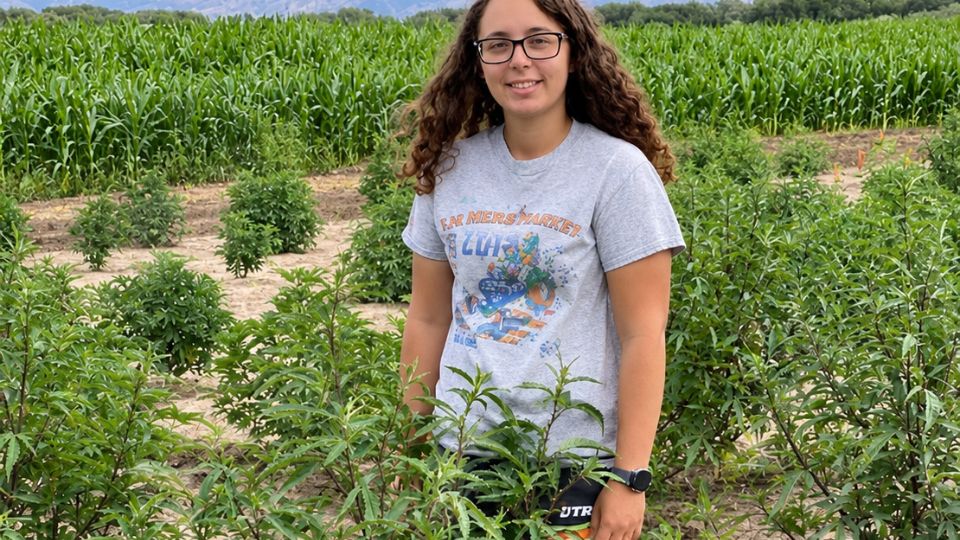
Authors provided the banner photo.
The authors used generative AI as a tool in the first drafting stage of this content from their own research, then refined and edited it; authors take full responsibility for the content.
References
This fact sheet summarizes the following three journal articles:
October 2026
Utah State University Extension
Authors
Matt Yost, Tina Sullivan, Bruce Bugbee, and Earl Creech

Matt Yost
Agroclimate Specialist
PSC Dept