
Reducing Residential Landscape Water Use in Utah: Technologies and Strategies

Utah faces an urgent need to conserve water as warmer weather and declining snowpack decrease supply and population growth increases demand. Outdoor residential water use accounts for about 11% of Utah’s annual water diversions, underscoring the importance of improving landscape irrigation efficiency (Utah Division of Water Resources [DWR], 2021; Clark et al., 2024). In this fact sheet, we describe options for Utahns looking to reduce residential water use, including:
- Smart irrigation controllers,
- Efficient sprinkler bodies and nozzles,
- Drip irrigation systems,
- Soil amendments that increase water-holding capacity, and
- Drought-tolerant grass cultivars for lawns.
Why Is Utah’s Water Supply at Risk?
Utah’s limited water supply is under growing pressure from both climate change and rapid population growth. Currently, warming temperatures are shifting more winter precipitation from snow to rain and causing earlier snowmelt and runoff (Hotaling & Becker, 2024). Because roughly 95% of Utah’s water comes from snowmelt, earlier runoff can decrease expected water supply during the spring and summer (DWR, 2025; Julander & Clayton, 2018). Additionally, summer temperatures in Utah are rising, especially in July (about 1 °F per decade since 1979), and this warming is increasing evaporative demand (DWR, 2021; Hotaling & Becker, 2024). At the same time, Utah's population is growing by 1.8% per year and is expected to double from 3 million to 6 million people by 2065 (U.S. Census Bureau, 2024; DWR, 2021). Collectively, these changes are increasing the need for Utahns to conserve water.
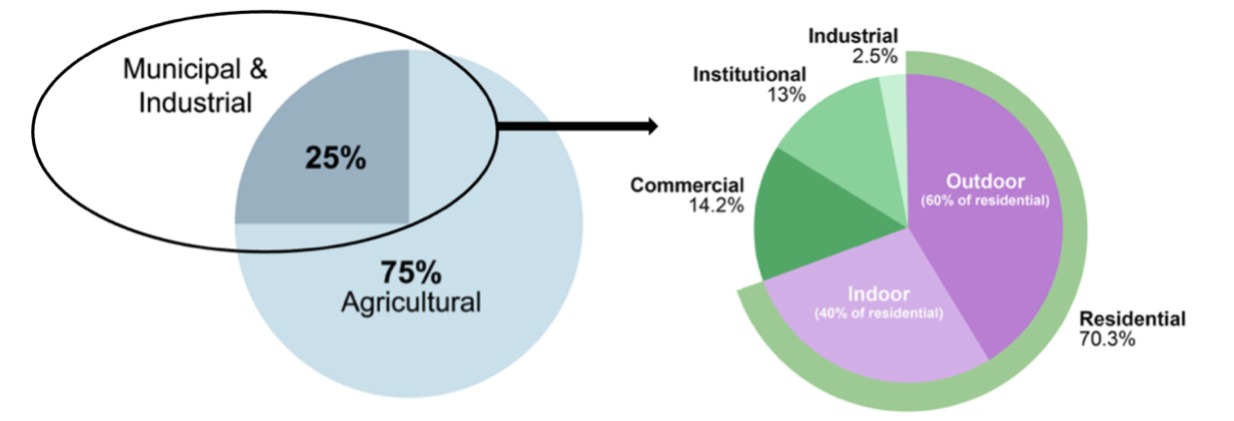
Note. Residential use accounts for over 70% of municipal and industrial diverted water, with 60% of residential water used outdoors.
Source: Modified from Clark et al., 2024.
Water Use in Utah
Source: Figure redrawn and modified from Pullen, 2023
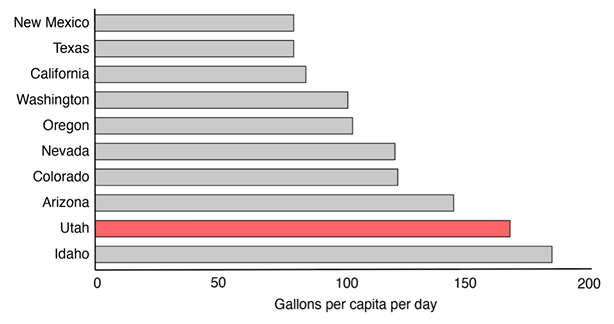
Utah receives an average of 61.3 million acre-feet of precipitation annually, of which 4.8 million acre-feet are diverted for human use (DWR, 2021). Around 75% of this diverted water supports agriculture, while the remaining 25% supports municipal and industrial needs (Figure 1, left; DWR, 2021). Of the portion allocated to municipal and industrial use, about 70% is used in residential settings, and of this water, roughly 60% is used to irrigate outdoor landscapes (about 504,000 acre-feet; Figure 1, right; DWR, 2021). While this may seem like a small proportion of the overall water diversions for the state, Utah residents have room for improvement when it comes to water use. The average U.S. resident uses 82 gallons of water per day, while the average Utahn uses more than twice that amount (U.S. Environmental Protection Agency [USEPA], 2024a; DWR, 2020). And, in 2015, Utah ranked second highest in per capita residential water use compared with other western states (Figure 2).
As Utah’s population grows and cities expand, patterns of land and water use are shifting. Between 1986 and 2015, 38% of newly urbanized areas along the Wasatch Range Metropolitan Area were formerly irrigated agricultural lands (Li et al., 2019). Thus, the proportion of Utah’s water supply that is going to municipal use will likely increase in the future.
Importance of Yard Vegetation
Despite growing concerns about water scarcity, many households still have lawns and associated vegetation. This is partly because lawns offer a range of benefits for homes when compared to bare soil or impermeable surfaces such as concrete. These benefits include improved air quality, natural cooling through transpiration, protection against soil erosion, and play areas for children (University of Minnesota Extension, 2024). And while lawns are sometimes viewed as a monoculture of poor wildlife habitat, the presence of shrubs, flowers, and trees in a landscape can provide animal habitat as well as visual appeal (University of Minnesota Extension, 2024). Because having vegetation on residential landscapes is important to many landowners, with about half of Americans actively maintaining their lawns, improving the technologies that support residential landscape care is essential for maximizing water efficiency and increasing sustainability (Ahn et al., 2024).
Residential Landscape Watering Technologies: Past to Present
Originally, landscape irrigation systems were controlled manually, with homeowners physically turning the systems on and off. In the 1960s, automatic timers were introduced and made watering more convenient, but this technology typically leads to overwatering lawns because they are programmed for peak watering needs rather than current weather conditions or the needs of specific plant types (Lunstad & Sowby, 2023).
Since the late 1990s, smart irrigation controllers have emerged as a more efficient irrigation system alternative for homeowners. These controllers use sensors and data to adjust watering schedules based on real-time conditions like weather and soil moisture. Modern smart controllers are more advanced than earlier models, offering more precise, hands-off irrigation management. This can save a home up to 15,000 gallons of water annually (USEPA, 2024c).
Despite these benefits, less than 10% of the 28 million sprinkler systems across the United States have smart controllers (Lunstad & Sowby, 2023). As a result, up to 50% of landscape irrigation water ends up wasted through unnecessary evaporation and runoff from overwatering (USEPA, 2024c). Below, we describe mechanical and biological technologies that can help Utahns reduce residential outdoor water use.
Water-Efficient Irrigation Technologies
Smart Irrigation Controllers
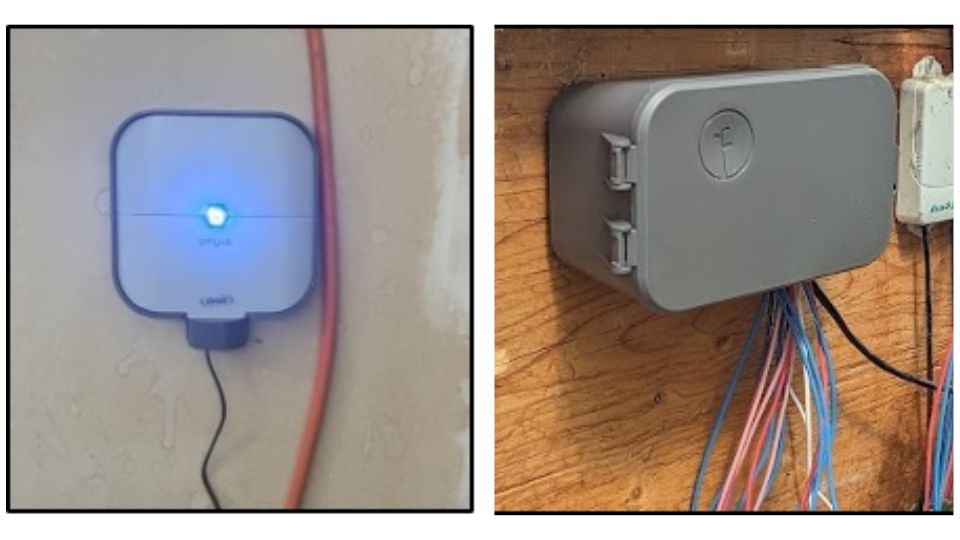
Smart irrigation controllers can adjust watering schedules based on data they collect (Figure 3). For example, weather-based controllers collect local evapotranspiration data, while controllers based on soil moisture sensors measure the soil’s moisture level. Controllers then use these data to determine when and how much to water. In one Utah-based study, smart irrigation controllers applied 30%–63% less water than a standard irrigation system (Evans et al., 2022). Utah has encouraged the adoption of smart irrigation controllers through its statewide rebate program, which has issued over 32,000 systems since 2018 (DWR, 2021).
WaterSense Spray Sprinkler Components
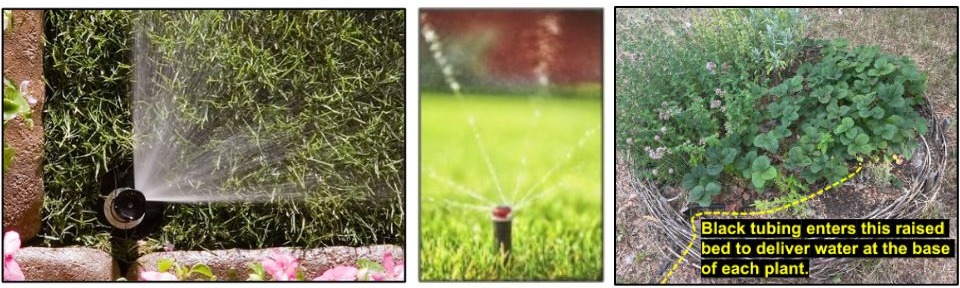
To promote efficient water use, the U.S. Environmental Protection Agency created the WaterSense label, which certifies that a product uses 20% less water than standard models while maintaining high performance and energy efficiency (USEPA, 2024a). The WaterSense label is being applied to new, more efficient versions of spray sprinkler bodies and nozzles. WaterSense-certified spray sprinkler bodies regulate the water pressure of the system, which is important for preventing waste from over-spraying and excessive pressure (Figure 4, left). The switch to WaterSense-certified spray sprinkler bodies with internal pressure regulation can save a home up to 5,600 gallons of water annually (USEPA, 2024b).
Sources: (left) USEPA, 2024b; (center) USEPA, 2025
The EPA is currently developing criteria for WaterSense-certified spray sprinkler nozzles that improve water efficiency. While the sprinkler body regulates the water pressure of the sprinkler system, the sprinkler nozzle controls its distribution. The goal of water-saving nozzles is to disperse the water more slowly, spread it more evenly, and reduce misting by elongating the droplets (Figure 4, center). These higher-efficiency spray nozzles are expected to save a home up to 2,400 gallons of water annually (USEPA, 2025).
Drip Irrigation Advancements
Unlike sprinkler systems that water entire areas, drip irrigation is effective for watering non-lawn vegetation because it can target the roots of specific plants and reduce water waste in “off-target” areas (Figure 4, right). Pressure-compensating emitters are improving drip irrigation by maintaining a constant flow rate regardless of pressure fluctuations, ensuring all plants receive the right amount of water even on sloped or uneven terrain (Burt & Feist, 2013). Installing drip irrigation under the surface further minimizes evaporation and runoff.
Landscape-Based Water Conservation Strategies
Compost, Manure, Peat Moss, and Biochar
While drip irrigation can minimize water loss through evaporation, water can still be lost as runoff or leaching when soil has low water-holding capacity. One way to improve soil water-holding capacity is to add organic matter to the soil in the form of compost, manure, peat moss, or biochar. An ideal garden soil should have about 5% organic matter, but Utah’s soils typically have just 0.25% to 1% (Davis et al., 2024; Heaton & Koenig, 2010). Each 1% increase in organic matter can increase soil water-holding capacity by 20,000 gallons per acre (Poudyal et al., 2024).
Drought-Tolerant Turfgrass Options
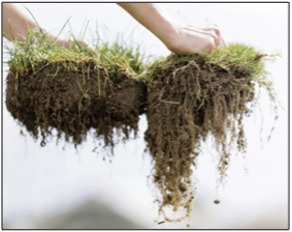
Source: Flores, 2024. Photo credit: Bradley Slade/Y Magazine/BYU, used with permission.
Choosing a drought-tolerant grass can improve water efficiency for lawns. While Kentucky bluegrass is the most common lawn grass used in Utah, it requires 24–30 inches of water over the course of Utah’s five-month watering period (Salt Lake City Public Utilities, n.d.). However, Utah residents who want to reduce the amount of water needed to maintain a lawn without letting their grass go dormant have promising alternatives to Kentucky bluegrass: hybrid bermudagrass, a warm-season cultivar, or tall fescue, a cool-season grass variety. Blends of bluegrass are also available that use substantially less water than their traditional counterparts (Center for Water-Efficient Landscaping [CWEL], 2023).
Hybrid bermudagrass is a drought-tolerant, warm-season grass that can reduce lawn water use by more than 60% compared to Kentucky bluegrass (Figure 5; Flores, 2024). This grass type was recently approved for residential use by the Utah Department of Agriculture and Food and is sold only as sod or sprigs. Hybrid bermudagrass must be planted in late spring or early summer to give the lawn enough time to properly root before winter. Hybrid bermudagrass stays green throughout the summer with minimal watering and can survive up to 6 weeks without irrigation, in part because of its extensive root system (Figure 5; Beazer, 2025; Burgin et al., 2022; Flores, 2024).
A more cost-effective option for Utah residents looking to improve lawn water efficiency is tall fescue because it is sold as seed rather than sod or sprigs. Tall fescue is a deep-rooted, drought-tolerant cool-season grass that is used in Trade Up!, a custom seed blend developed for Salt Lake City’s grass replacement program (Salt Lake City Public Utilities, n.d.). Trade Up! combines tall fescue with a small amount of Kentucky bluegrass for improved durability and appearance. Unlike hybrid bermudagrass, Trade Up! lawns stay green longer into the fall and green up earlier in spring. Trade Up! lawns also require 30% less water than traditional bluegrass (Salt Lake City Public Utilities, n.d.). Other drought-tolerant grass blends are sold by local sod and seed vendors, including Biograss Sod, Chanshare Sod, and Granite Seed (CWEL, 2023).
Water-Wise Landscaping
Water-wise landscaping refers to designing residential landscapes with native and/or drought-tolerant plants in place of water-intensive ornamental shrubs and trees to reduce outdoor water use. This approach informs the selection of plant species, their appropriate maintenance, and their placement in the yard––grouping plants with similar water needs and positioning them according to factors like sun exposure, shade, and soil conditions. Not overwatering vegetation, whether the plants are “water-wise” or not, is also key. For more information on water-wise landscaping, see these resources and USU Extension fact sheets:
- Designing water-wise landscapes (LAEP, n.d.).
- Finding water-wise plants (Conservation Garden Park, n.d.).
- Applying water-wise landscaping principles (CWEL, n.d.).
- Implementing water-wise landscapes (LAEP, n.d.).
- Using water-wise landscaping policies and programs (Clark et al., 2024).
- Efficiently irrigating trees and shrubs (Cerny et al., 2022).
- Knowing how much to water trees (Poudyal, 2022).
Resources for Water-Efficient Landscapes in Utah
Several programs incentivize Utah residents to make water-conscious landscaping choices (Table 1). Additionally, the state provides resources to inform people about changing weather and water conditions throughout the state.
Table 1. Resources for Water-Efficient Landscapes Offered By or For the State of Utah
| Resource | Summary | Additional Information |
|---|---|---|
| Smart controller rebates | Utah Water Savers offers a rebate of up to $100 when residents purchase an eligible water-efficient smart controller. | Verify your smart controller product is eligible for a rebate here before purchasing. |
| Expanded turf buyback | Utah Water Savers offers rebates up to $3 per square foot of lawn replaced with water-efficient landscaping (must include at least 50% plant coverage). | Incentives differ; check your city’s specific guidelines. |
| Turfgrass Water Conservation Alliance | Turfgrass Water Conservation Alliance (TWCA) is a nonprofit that certifies drought-tolerant grass varieties. | A map on the TWCA website shows five vendors in northern Utah that sell TWCA-certified sod and seed. |
| Secondary water meters | All secondary (non-potable irrigation) water connections must be metered by 2030. Current locations receiving service can be viewed on the Utah Secondary Water Metering website. | Metering is completed by water suppliers at no up-front cost to consumers. |
| Water Check | USU Center for Water-Efficient Landscaping Extension Offices offer free water check consultations and provide customized irrigation schedules for pre-existing turf lawns. | This DIY water check resource is useful for landowners outside the free water check area. |
| Drought map | U.S. Drought Monitor provides maps of states’ drought conditions by county. Archived maps and week-to-week comparisons are available. | Updated weekly |
| Watering guidelines | The Utah Department of Natural Resources provides a map of Utah counties with recommended lawn watering guidelines for traditional and low-water-use lawns based on drought conditions. | Updated weekly |
| Water-efficient landscaping | The Central Utah Water Conservancy District offers landscaping classes focusing on local water-efficient plants and converting non-functional grass areas. | Current class offerings vary; see past classes for examples. |
Conclusion
Water conservation is a critical issue in Utah, and several actions are already underway to help lower residential landscape water use. While additional conservation efforts will be necessary to reach sustainable water management, statewide adoption of current programs can help reduce water use and loss.
Acknowledgments
This publication is the product of a partnership between the Climate Adaptation Intern Program (CAIP) and Swaner Preserve & EcoCenter in Summit County, Utah. CAIP was supported by the “Secure Water Future” project, funded by an Agriculture and Food Research Initiative Competitive Grant (#2021-69012-35916) from the USDA National Institute of Food and Agriculture, as well as funding from USU Extension and a USU Extension Water Initiative Grant. We improved this fact sheet based on feedback from Kelly Kopp, Ph.D., Sara Jo Dickens, Ph.D., and CAIP participants.
For correspondence, contact Scott Hotaling: scott.hotaling@usu.edu
References
- Ahn, S., Luo, Q., Mendoza, S., & Norwood, F. B. (2024). Rethinking the traditional American lawn: Perspectives of U.S. households in a nationwide survey. Urban Forestry & Urban Greening, 99, 128460. https://doi.org/10.1016/j.ufug.2024.128460
- Banks, J. E. (2012). Designing a basic PVC home garden drip irrigation system [Fact sheet]. Utah State University Extension. https://digitalcommons.usu.edu/extension_curall/1055/
- Beazer, A. J. (2025). Hybrid Bermudagrass drought tolerance in a cool-season climate (Master's thesis, Brigham Young University). BYU ScholarsArchive. https://scholarsarchive.byu.edu/etd/10781
- Burgin, H. R., Wear, G. A., Hansen, N. C., & Hopkins, B. G. (2022). Variable impacts on growth of deficit irrigation on Cynodon dactylon (L.) Pers. × Cynodon transvaalensis Burtt Davy and Poa pratensis L. International Turfgrass Society Research Journal, 14(1), 152–156. https://doi.org/10.1002/its2.71
- Burt, C. M., & Feist, K. (2013). Pressure-compensating emitter characteristics. Irrigation Association. https://www.irrigation.org/IA/FileUploads/IA/Resources/TechnicalPapers/2013/PressureCompensatingEmitterCharacteristics.pdf
- Center for Water-Efficient Landscaping. (2023, June 6). Utah State University Extension. https://extension.usu.edu/cwel/news/low_wateruse_turf
- Center for Water-Efficient Landscaping. (n.d.). Principles of water wise landscaping. Utah State University Extension.
- Cerny, T. A., Kuhns, M., Kopp, K. L., & Johnson, M. (2022, June). Efficient irrigation of trees and shrubs [Fact sheet]. USU Extension.
- Clark, C., Becker, K., Wagner, K., & Hotaling, S. (2024, September). Policies and programs for water-wise residential landscaping in Utah [Fact sheet]. Utah State University Extension. https://extension.usu.edu/climate/research/water-wise-policies-and-programs-utah
- Conservation Garden Park. (n.d.). Find waterwise plants. Jordan Valley Water Conservation District.
- Davis, J. G., Whiting, D., Oleszak, H., Hammond, E., & Murgel, J. (2024). Choosing a soil amendment [Fact sheet]. Colorado State University Extension. https://extension.colostate.edu/topic-areas/yard-garden/choosing-a-soil-amendment/
- Evans, S. R., Kopp, K., Johnson, P. G., Hopkins, B., Dai, X., & Schaible, C. (2022). Comparing smart irrigation controllers for turfgrass landscapes. HortTechnology, 32(5), 415–424. https://doi.org/10.21273/HORTTECH04985-21
- Flores, J. (2024). A greater grass. Y Magazine. https://magazine.byu.edu/article/hybrid-bermudagrass-byu-research/
- GIZ Bush Control and Biomass Utilisation Project. (2022, March 19). File:Biochar ready for application.jpg [Photograph]. Wikimedia Commons. https://commons.wikimedia.org/wiki/File:Biochar_ready_for_application.jpg
- Heaton, K., & Koenig, R. (2010). Solutions to soil problems V. low organic matter [Fact sheet]. Utah State University Extension. https://extension.usu.edu/yardandgarden/research/solutions-to-soil-problems-v-low-organic-matter
- Hotaling, S., & Becker, K. M. L. (2024). Recent climate change in Utah, 1870–2023 [Fact sheet]. Utah State University Extension. https://digitalcommons.usu.edu/extension_curall/2453/
- Julander, R. P., & Clayton, J. A. (2018). Determining the proportion of streamflow that is generated by cold season processes versus summer rainfall in Utah, USA. Journal of Hydrology: Regional Studies, 17, 36–46. https://doi.org/10.1016/j.ejrh.2018.04.005
- Landscape Architecture and Environmental Planning (LAEP). (n.d.). Water-wise landscape design series. Utah State University Extension.
- Li, E., Endter-Wada, J., & Li, S. (2019). Dynamics of Utah’s agricultural landscapes in response to urbanization: A comparison between irrigated and non-irrigated agricultural lands. Applied Geography, 105, 58–72. https://doi.org/10.1016/j.apgeog.2019.02.006
- Lunstad, N. T., & Sowby, R. B. (2023). Smart irrigation controllers in residential applications and the potential of integrated water distribution systems. Journal of Water Resources Planning and Management, 150(1). https://doi.org/10.1061/JWRMD5.WRENG-5871
- National Association of Landscape Professionals. (n.d.). Research confirms Americans still value lawns and green spaces. Retrieved June 17, 2025, from https://www.landscapeprofessionals.org/LP/LP/Media/2019-press-releases/Research_Confirms_Americans_Still_Value_Lawns_and_Green_Spaces.aspx
- Powell, J., & Zwahlen, R., Kopp, K., Poudyal, S., & Schaible, C. (n.d.). Water-wise landscape implementation [Fact sheet]. Utah State University Extension. https://extension.usu.edu/laep/research/landscape-implementation
- Poudyal, S. (2022, July). How much water do landscape trees require in Utah? An irrigation calculator [Fact sheet]. USU Extension.
- Poudyal, S., Powell, J., Zwahlen, R., & Cardon, G. (2024). Commercially available products to increase soil water-holding capacity for gardens and landscapes [Fact sheet]. Utah State University Extension. https://extension.usu.edu/laep/research/commercially-available-products-to-incease-soil-water-holding
- Pullen, J. (2023, August 2). Arizona’s water use by sector. Making Action Possible for Southern Arizona. https://mapazdashboard.arizona.edu/article/arizonas-water-use-sector
- Salt Lake City Public Utilities. (n.d.). SLC turf trade. Salt Lake City Government. Retrieved April 9, 2025, from https://www.slc.gov/utilities/conservation/slcturftrade/
- University of Minnesota Extension. (2024). Environmental benefits of lawns [Fact sheet]. University of Minnesota. https://extension.umn.edu/lawn-care/environmental-benefits-lawns
- U.S. Census Bureau. (2024, December). Net international migration drives highest U.S. population growth in decades. https://www.census.gov/newsroom/press-releases/2024/population-estimates-international-migration.html
- U.S. Environmental Protection Agency (USEPA). (2024a). About WaterSense. EPA. https://www.epa.gov/watersense/about-watersense
- U.S. Environmental Protection Agency. (2024b). Spray sprinkler bodies. https://www.epa.gov/watersense/spray-sprinkler-bodies
- U.S. Environmental Protection Agency. (2024c). WaterSense labeled controllers. https://www.epa.gov/watersense/watersense-labeled-controllers
- U.S. Environmental Protection Agency. (2025). Spray sprinkler nozzles. https://www.epa.gov/watersense/spray-sprinkler-nozzles
- Utah Division of Water Resources (DWR). (2020). 2015 Municipal and Industrial Water Use Data (2020 Version 3). https://water.utah.gov/wp-content/uploads/2020/07/2015WaterDataV3.pdf
- Utah Division of Water Resources. (2021, December). Water resources plan. https://water.utah.gov/wp-content/uploads/2022/01/Water-Resources-Plan-Single-Page-Layout.pdf
- Utah Division of Water Resources. (2025, January). Utah water conditions update. https://water.utah.gov/utah-water-conditions-update-january-2025/

August 2025
Utah State University Extension
Peer-reviewed fact sheet
Authors
Maya Cottam1, Kendall Becker1,2, Katlyn Stemmler2, Shital Poudyal3, Wesley Crump4, Lewis Kogan5, Scott Hotaling1,2
1 Utah State University (USU) Climate Adaptation Intern Program
2 USU Department of Watershed Sciences
3 USU Department of Plants, Soils, and Climate
4 USU Extension Agriculture and Natural Resources
5 Swaner Preserve & EcoCenter, USU

Shital Poudyal
Assistant Professor | Ornamental Horticulture Specialist
Plants, Soils and Climate

Wesley Crump
Extension Assistant Professor | Horticulture | Wasatch County
Agriculture and Natural Resources

Lewis Kogan
Executive Director | Swaner Preserve and EcoCenter
Agriculture and Natural Resources

Scott Hotaling
Assistant Professor | Climate Resiliency Specialist
Watershed Sciences
Related Research