
Post-Wildfire Erosion and Sedimentation: An Escalating Threat for Utah’s Fisheries

Highlights
- Increasing wildfire size and severity––and Utah’s heavily engineered and fragmented stream networks––pose a risk to fish populations.
- Wildfire leaves soils vulnerable to erosion.
- After wildfire, heavy rains can wash large amounts of sediment into rivers.
- Fish living in affected watersheds can die from respiratory distress.
- Loss of spawning habitat from sediment deposition can hinder population recovery.
- Removing migration barriers, managing vegetation to reduce fuel, and using sediment traps can lower the risk of wildfire damage to Utah’s fisheries.
Wildfires are a natural part of the western U.S. landscape and provide many benefits in terms of nutrient cycling and habitat rejuvenation. Utah’s fish populations evolved with wildfire as a common disturbance. However, the increasing size and severity of wildfires, combined with Utah’s heavily engineered and fragmented stream networks, pose a contemporary risk to fish populations. When wildfires are followed by heavy rainfall, soil erosion can deliver large amounts of sediment to streams and rivers. Fish living in affected watersheds, and especially those with barriers to migration, can face respiratory distress and loss of spawning habitat post-fire.
Forest and watershed management practices have contributed to this problem. Fire exclusion has allowed fuel to build up, increasing fire severity, and dams and other barriers have isolated fish populations, meaning they can get trapped in temporarily lethal areas.
Climate change is amplifying these risks to Utah’s fisheries. Warming temperatures and declining snowpack are causing the fire season to start earlier and end later. Moreover, drier fuel is increasing fire size and severity, which can increase erosion into streams. Short-term solutions to reduce risks and enhance potential benefits of wildfires to fisheries include:
- Removing migration barriers to allow fish to escape from and later repopulate severely burned areas.
- Managing vegetation and using prescribed fire to proactively reduce fuel.
- Using sediment traps and restoring riparian areas to reduce post-fire erosion.
As fires continue to burn in Utah, the health of Utah’s aquatic ecosystems will also depend on lowering fire severity by cutting greenhouse gas emissions to reduce global warming.
Wildfire in Utah’s Watersheds
A watershed is an area that channels precipitation downhill into rivers, lakes, and oceans (Figure 1). Utah’s watersheds have experienced wildfire for millennia (Brown et al., 2008; Carter et al., 2021). Before Euro-Americans began settling in Utah in 1847, wildfires occurred naturally via lightning ignition but were also intentionally started by Indigenous peoples, including the Fremont, Navajo, Paiute, Shoshone, and Ute (Williams, 2003; Carter et al., 2021). From 1630 to 1900, regional-size fires occurred every 8 years on average, and forested areas typically burned every 11–60 years (Brown et al., 2008; McGinty & McGinty, 2009). Following Euro-American settlement, intentional burns were criminalized, and federal agencies were created to suppress natural fires (McGinty & McGinty, 2009). These efforts were especially effective between 1930 and 1960, allowing fuel to accumulate (Birch & Lutz, 2024; McGinty & McGinty, 2009).

Today, fires in Utah are both necessary and unavoidable due to high fuel loads paired with warmer temperatures and longer fire seasons caused by climate change (Murphy et al., 2018; Birch & Lutz, 2024; Hotaling & Becker, 2024). Because many of Utah’s developed areas are adjacent to flammable ecosystems, fire suppression is still actively practiced (Birch & Lutz, 2024). From 1980 to 2007, Utah experienced approximately 24,000 ignitions, most of which were extinguished before they exceeded 10 acres (McGinty & McGinty, 2009). Between 1984 and 2022, 1,472 wildfires ≥100 acres burned in Utah, and 697 of these were ≥1,000 acres (Figure 2; Birch & Lutz, 2024).

Note: The Twitchell Canyon Fire (2010), Seeley Fire (2012), and West Valley Fire (2018) are examples of fires in Utah that have impacted fish populations. Data sources: Birch & Lutz, 2024; Utah Division of Wildlife Resources (DWR), n.d.
How Do Wildfires Impact Soil Erosion?
After a wildfire moves through a landscape, the soils are left vulnerable to erosion, and more sediment can make its way into rivers (Bladon et al., 2014; Murphy et al., 2019). Erosion is a natural process where soil, rock, or surface material is gradually removed and deposited elsewhere by wind or water. The rate of erosion, however, can surge after fire due to loss of vegetation and the formation of water-repellent soil (Bladon et al., 2014). In an unburned landscape, vegetation shields soil from wind and stabilizes slopes by anchoring soil with its root systems. Vegetation, especially the leaves on plants, also helps slow down rainfall, so soil is less likely to become over-saturated. When fire damages or kills plants, their ability to limit erosion is reduced. Erosion rates can also increase when decomposing plant matter burns in soils, creating a layer of waxy, organic compounds that inhibit water absorption (Figure 3; Neary, 2004). These water-repellent soils prevent rainfall from infiltrating into the soil, and the runoff can wash loose soil, ash, and organic debris of all sizes––from tiny particles to entire trees––into waterways.

Source: U.S. Forest Service, n.d.
Fish in Utah’s Watersheds
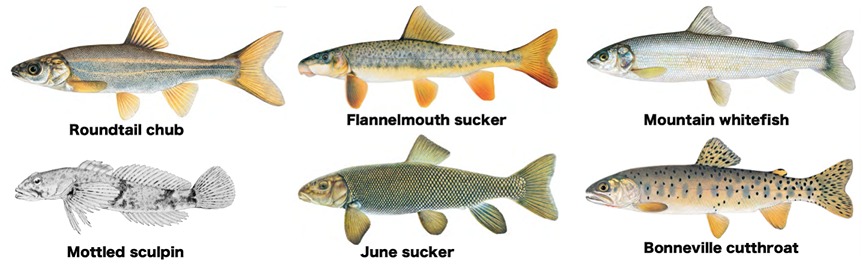
Utah’s watersheds contain over 30 species of native fish, including chub, sculpin, suckers, and whitefish, as well as Utah’s prized state fish, the Bonneville cutthroat trout (Figure 4; Wild About Utah, 2024). Additionally, introduced species, such as rainbow, brook, and brown trout, have become integral to Utah's fisheries (Figure 5; Utah Division of Wildlife Resources [DWR], 2024). Many of these species demonstrate migratory behaviors, moving among lakes, rivers, and tributaries during different life stages (Burton, 2005). Diverse habitats support different species and life stages of fish. The ability to access suitable habitats and escape unfavorable conditions is necessary for the long-term persistence of these culturally, ecologically, and economically important species.
Streams and rivers are natural highways for fish. The ability of fish to move among habitats is, however, influenced by both natural and human-made barriers. While Utah’s fish are adapted to the presence of natural barriers (such as waterfalls and intermittent stream sections), the rapid expansion of human-made barriers (such as dams, diversions, and culverts) over the past century has greatly increased the number of barriers to fish movement (Utah Wildlife Migration Initiative, 2025).
Sources: Utah DWR, 2024; Edmonson, 1926

Source: Utah DWR, 2024
Utah’s Blue Ribbon Fisheries
Utah currently hosts 693 lakes and 256 streams designated as Blue Ribbon fisheries, recognized for their exceptional fishing opportunities, ecological significance, and economic contribution to outdoor recreation (Figure 2; Utah DWR, 2025). Of these, 111 are located within the perimeters of wildfires ≥100 acres that burned between 1984 and 2021, and 110 are in watersheds that experienced wildfires ≥1,000 acres during that period (Figure 2). Blue Ribbon fisheries receive substantial investment to maintain pristine conditions and robust fish populations. Managing these areas before and after wildfire is especially important.
How Does Post-Wildfire Erosion Affect Fish?
The impact of post-fire erosion on fish populations depends on subsequent weather events and the ability of fish to migrate freely throughout waterways (Burton, 2005; Gomez Isaza et al., 2022). Post-wildfire erosion can impact fish through its effects on water quality and physical habitat structure. Specifically:
- Large amounts of sediment and organic material washed into rivers can clog gills, impair vision, and reduce the availability of dissolved oxygen in streams, potentially causing respiratory problems, decreased ability to see prey, and/or death (Dahm et al., 2015; Gomez Isaza et al., 2022).
- Cloudy water reduces the amount of light reaching aquatic vegetation. When submerged plants photosynthesize less, they produce less dissolved oxygen for fish and other organisms (Gomez Isaza et al., 2022).
- Many fish, including cutthroat trout, rely on clean, gravel-rich stream beds for spawning. Large inflows of silt and sand after wildfire can cover these areas and reduce reproduction rates (Burton, 2005).
- Inputs of fallen trees and coarse sediment (i.e., gravel and boulders) after wildfires can rejuvenate habitat for fish (Burton, 2005). However, excessive inputs of coarse sediment can create migration barriers, limiting the ability of fish to both escape from and repopulate wildfire-impacted rivers.
- Sediment can accumulate on banks, disconnecting rivers from their floodplains, which can be seasonally important habitat for fish.
These effects become especially detrimental if waterways are disconnected by dams, areas of low flow, or impassible culverts (Burton, 2005). For example, Utah has 1,363 dams and other barriers, which can block fish from escaping lethal conditions and prevent them from naturally repopulating areas after the local fish population has been killed (Utah Wildlife Migration Initiative, 2025).
Impacts of Post-Wildfire Erosion on Utah’s Fisheries
In Utah, the impact of sediment deposition in streams after wildfire is a significant concern for the conservation of fish. Utah’s native fish are adapted to natural disturbances, including wildfire, and even rely on them to create and maintain their complex habitats (Gresswell, 1999). However, today’s higher fire severity and disconnected waterways put fish at risk.
For instance, post-fire erosion from the 2010 Twitchell Canyon Fire (Figure 2) severely degraded water quality, fragmented spawning areas, and nearly extirpated local populations of the native Bonneville cutthroat trout (Murphy et al., 2019). Post-wildfire sediment deposition events have also caused large fish die-offs. The 2012 Seeley Fire in Carbon and Emery counties (Figure 2; Clancy, n.d.) burned more than 47,000 acres in the Huntington Creek watershed. After the fire was extinguished, a large rainstorm caused massive debris flows that carried sediment, ash, and debris downstream. This resulted in a complete loss of fish populations, including cutthroat trout, in the lower section of Huntington Creek (Clancy, n.d.).
Given the potentially devastating impacts of wildfires on fish, managers have at times intervened to reduce impacts before they occurred. In 2018, when the West Valley Fire in southwestern Utah (Figure 2) threatened native cutthroat trout habitat, Utah’s DWR relocated 400 trout to a nearby hatchery to protect them until stream conditions recovered (Maffly, 2018). However, while actively moving fish can avoid immediate threats, these efforts are labor-intensive and may be difficult to scale up. As an article discussing the West Valley Fire in Trout Unlimited observed, "…this is a commendable response from our state wildlife agencies to save these unique fish, but it begs questions like, do we have a place to move fish populations in an emergency? Can we really keep up with fires by saving populations?" (Prettyman, 2018). These efforts highlight the need to reconnect waterways so fish populations can survive and repopulate areas independently (Rust et al., 2019).

Habitat Recovery After Wildfire
After wildfire, habitat recovery is characterized by regrowth of riparian and upslope vegetation, stabilized sediments, and a return to pre-fire sediment composition in the waterways. The recovery of fish habitat following wildfire varies based on watershed characteristics (e.g., hillslope and river channel gradients, valley bottom width, and river confinement), fire severity, post-fire weather, the extent of erosion, and mitigation efforts (Gomez Isaza et al., 2022). Determining the best rehabilitation and management actions after a wildfire requires a thorough evaluation of in-stream habitat conditions, the area’s susceptibility to erosion, and how sediment may move through the affected waterways in the future. In some cases, the best outcomes may result from simply allowing a large amount of sediment and wood to be deposited in the river and then giving the river time to move it around and create new habitat (Figure 6; Burton, 2005). This is also typically the most cost-effective approach but may be too slow to meet societal expectations. Alternatively, it can be beneficial to actively manage hillslope erosion, manipulate sediment or wood in the stream channel, introduce restorative species such as beaver, or implement more directed restoration of fish habitat.
Vegetation recovery on hillslopes can take 2–20+ years, depending on vegetation type, soil conditions, and fire severity (Gomez Isaza et al., 2022). Often, riparian vegetation re-establishes within 5–10 years after wildfire, stabilizing streambanks and reducing further erosion (Burton, 2005). This vegetation also lowers water temperatures by shading streams, provides organic material that supports aquatic life, and attracts insects that fish eat (Gomez Isaza et al., 2022). However, larger or repeated fires in the same watershed can prolong recovery times. Restoration efforts, such as replanting native vegetation along streambanks, placing logs along contour lines or at specific locations within the stream channels, and covering the ground with straw or wood mulch, can reduce erosion and facilitate faster recovery for fish populations (Girona-Garcia, 2021). Straw wattles, a form of sediment trap consisting of cylindrical tubes made from compressed straw or plant fibers encased in biodegradable mesh, can also reduce sediment movement (Girona-Garcia, 2021). The wattles slow water and catch larger sediment, which may be beneficial in some circumstances––or detrimental if coarse sediment is needed to rejuvenate in-stream habitat.
How Can We Prevent Post-Wildfire Fish Die-Offs?
Given that wildfires will continue to burn, several management actions can help these fires benefit rather than threaten fish populations and habitat:
- Reconnecting waterways so fish can escape to refuge habitat and later repopulate burned areas is a key step (Burton, 2005; Rust et al., 2019). So far, just 30 out of 1,393 barriers in Utah’s streams have been modified or removed (Utah Wildlife Migration Initiative, 2025). However, decisions to remove or modify barriers must consider the potential impacts of allowing the spread of invasive species (Fausch et al., 2009; Milt et al., 2018).
- Prescribed fire, patch clearing, creating fire breaks, and thinning can help reduce fuel loads so when wildfires burn, they are less severe and, therefore, less destructive to nearby aquatic habitats (McGinty & McGinty, 2009).
- Reintroducing beaver and allowing them to restore degraded riparian habitats can also lower fire severity (Fairfax et al., 2024).
- Curbing increases in summer temperatures and fire season length can help reduce fire severity as well. To prevent additional warming, lowering carbon emissions released from burning fossil fuels is essential (U.S. Global Change Research Program, 2023). While Utah cannot, by itself, solve the global problem of carbon pollution, we can make a difference, and many opportunities exist to lead by example (Cameron et al., 2024; Erwin et al., 2024; Michaels et al., 2024; Storrud et al., 2024).
Acknowledgments
This publication was produced as part of the Climate Adaptation Intern Program (CAIP) at Utah State University. CAIP was supported by the “Secure Water Future” project, funded by an Agriculture and Food Research Initiative Competitive Grant (#2021-69012-35916) from the USDA National Institute of Food and Agriculture, as well as support from the USGS Southwest Climate Adaptation Science Center, USU Extension, and the USU Extension Water Initiative. We improved this fact sheet based on feedback from USU Extension’s CAIP participants.
For correspondence, contact Patrick Belmont: patrick.belmont@usu.edu.
References
- Birch, J. D., & Lutz, J. A. (2023). Fire regimes of Utah: The past as prologue. Fire, 6(11), 423. https://doi.org/10.3390/fire6110423
- Bladon, K. D., Emelko, M. B., Silins, U., & Stone, M. (2014). Wildfire and the future of water supply. Environmental Science & Technology, 48(16), 8936–8943. https://doi.org/10.1021/es500130g
- Brown, P. M., Heyerdahl, E. K., Kitchen, S. G., & Weber, M. H. (2008). Climate effects on historical fires (1630–1900) in Utah. International Journal of Wildland Fire, 17, 28–39. https://doi.org/10.1071/wf07023
- Burton, T. A. (2005). Fish and stream habitat risks from uncharacteristic wildfire. Forest Ecology and Management, 211, 140–149. https://doi.org/10.1016/j.foreco.2005.02.063
- Cameron, R., Becker, K., Lamm, A., & Hotaling, S. (2024). Could a carbon tax improve Utah's air quality? [Fact sheet]. USU Extension. https://digitalcommons.usu.edu/extension_curall/2447/
- Carter, V. A. et al. (2021). Indigenous land use and wildfire regimes. Communications Earth & Environment, 2(72). https://doi.org/10.1038/s43247-021-00137-3
- Clancy, C. (n.d.). After the fire: Huntington Creek. The FlyFish Journal. https://www.theflyfishjournal.com/exclusive/after-the-fire/
- Dahm, C. N. et al. (2015). Water quality degradation after forest fire. Freshwater Biology, 60(12), 2584–2599. https://doi.org/10.1111/fwb.12548
- Edmonson, E. (1926). Cottus bairdii [Painting]. Wikimedia Commons. https://en.wikipedia.org/wiki/File:Cottus_bairdii.jpg
- Erwin, I. et al. (2024). Sustainable transportation in Utah [Fact sheet]. USU Extension. https://digitalcommons.usu.edu/extension_curall/2439/
- Fairfax, E. et al. (2024). Beaver dams and burn severity. Biogeomorphic Responses to Wildfire, 131–151. https://doi.org/10.1130/2024.2562(07)
- Fausch, K. D. et al. (2009). Invasion vs. isolation in salmonid management. Conservation Biology, 23(4), 859–870.
- Girona-Garcia, A. et al. (2021). Effectiveness of post-fire erosion treatments. Earth-Science Reviews, 217, 103611. https://doi.org/10.1016/j.earscirev.2021.103611
- Gomez Isaza, D. F. et al. (2022). Wildfire runoff and aquatic fauna. Global Change Biology, 28, 2578–2595. https://doi.org/10.1111/gcb.16088
- Gresswell, R. E. (1999). Fire and aquatic ecosystems. Transactions of the American Fisheries Society, 128(2), 193–221.
- Hotaling, S., & Becker, K. M. L. (2024). Climate change in Utah [Fact sheet]. USU Extension. https://digitalcommons.usu.edu/extension_curall/2453/
- Maffly, B. (2018). Saving trout from fire. Salt Lake Tribune. https://www.sltrib.com/news/environment/2018/07/11/dwr-rushes-save-hundreds/
- McGinty, E. I. L., & McGinty, C. (2009). Fire in Utah. https://extension.usu.edu/rangelands/files/RRU_Final.pdf
- Michaels, K. et al. (2024). Cap-and-trade in Utah [Fact sheet]. USU Extension. https://digitalcommons.usu.edu/extension_curall/2431/
- Milt, A. W. et al. (2018). Connectivity restoration trade-offs. Conservation Biology, 32(4), 894–904.
- Murphy, B. P. et al. (2018). Modern wildfire and water risks. Earth’s Future, 6(11), 1492–1497. https://doi.org/10.1029/2018EF001006
- Murphy, B. P. et al. (2019). Sediment cascades post-wildfire. Earth Surface Processes and Landforms, 44(11), 2126–2140. https://doi.org/10.1002/esp.4635
- Neary, D. G. (2004). Fire effects on soils. Southwest Hydrology, 3(5), 18–19. USDA link
- Prettyman, B. (2018). Flames and fish. Trout Unlimited. https://www.tu.org/magazine/conservation/flames-and-fish-a-growing-issue-in-the-west/
- Rust, A. J. et al. (2019). Wildfire impacts on trout. Forest Ecology and Management, 453, 117636. https://doi.org/10.1016/j.foreco.2019.117636
- Storrud, S. et al. (2024). Artificial carbon sequestration [Fact sheet]. USU Extension. https://digitalcommons.usu.edu/extension_curall/2425/
- Utah DWR. (2024). Fishing guidebook. https://wildlife.utah.gov/guidebooks/fishing_guidebook.pdf
- Utah DWR. (2025). Blue ribbon fisheries. https://wildlife.utah.gov/blue-ribbon-fisheries.html
- Utah DWR. (n.d.). Fish Utah. https://dwrapps.utah.gov/fishing/fStart?TY=Blue%20Ribbon
- Utah Wildlife Migration Initiative. (2025). Barriers. https://wildlifemigration.utah.gov/fish-and-amphibians/barriers/
- U.S. Forest Service. (n.d.). Burn scars are a flood risk. https://www.fs.usda.gov/detail/mbr/fire/?cid=FSEPRD889210
- U.S. Global Change Research Program. (2023). Fifth national climate assessment. https://doi.org/10.7930/NCA5.2023
- Wild About Utah. (2024). 32 native fish species of Utah [Video]. https://www.youtube.com/watch?v=FAV-eqVWh9k
- Williams, G. W. (2003). American Indian use of fire. USDA Forest Service. https://sipnuuk.karuk.us/digital-heritage/references-american-indian-use-fire-ecosystems-0

July 2025
Utah State University Extension
Peer-reviewed fact sheet
Authors
Colton James1, Kendall Becker1,2, Scott Hotaling1,2, Aish Chandrasekaran3, Alex Fielder3, Timothy E. Walsworth 2,4, Patrick Belmont2
1Utah State University (USU) Climate Adaptation Intern Program
2USU Department of Watershed Sciences
3USU Department of Environment and Society
4USU Ecology Center

Scott Hotaling
Assistant Professor | Climate Resiliency Specialist
Watershed Sciences
Related Research