
Geothermal Energy in Utah: A Safe Technology With Limited Environmental Impacts
Geothermal energy––heat from the
Earth’s core––can provide steady,
flexible electricity while producing
nearly zero carbon emissions.
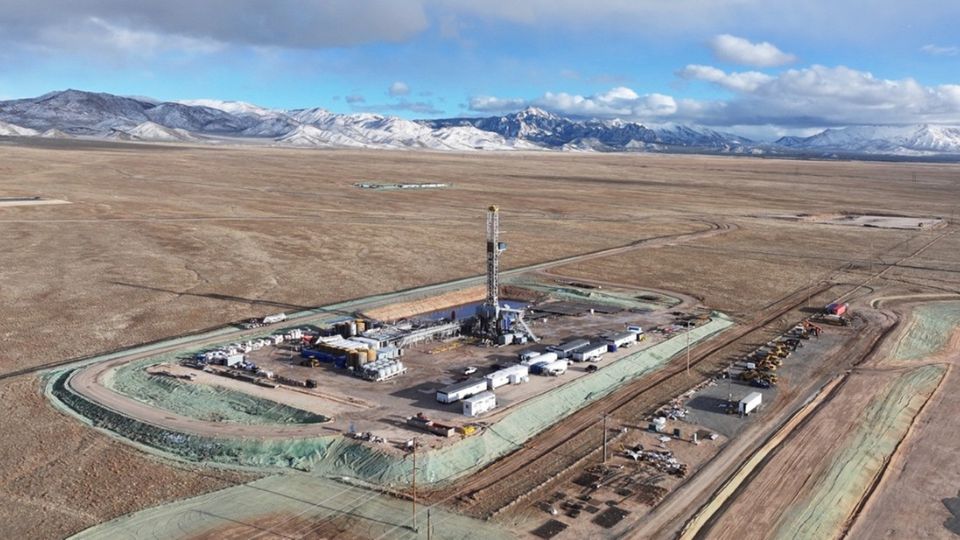
In 2024, 78% of Utah’s electricity was generated from burning coal (45%) and natural gas (33%), which emit pollution and carbon dioxide that reduce air quality and contribute to climate change (U.S. Energy Information Administration [EIA], 2025a; Utah Division of Air Quality, 2023). One rapidly emerging cleaner option is geothermal energy development—tapping the Earth’s internal heat to generate electricity (Figure 1). A key strength of geothermal energy is its ability to deliver consistent power with near-zero carbon emissions (Horne et al., 2025). Unlike solar and wind, which depend on sunlight and weather, geothermal energy can enhance grid reliability by providing steady, baseload electricity or flexible, dispatchable electricity depending on needs and implementation (Aljubran & Horne, 2024). Because geothermal power plants emit little to no air pollution and carbon dioxide, expanding Utah’s geothermal capacity could help improve air quality and reduce greenhouse gas emissions statewide (Utah Division of Air Quality, 2023).
Conditions favorable for geothermal energy development occur where the Earth’s internal heat is near the surface, making it accessible through drilling (U.S. Department of Energy [DOE], n.d.-a). However, extracting this heat via geothermal wells raises environmental questions. Here, we provide an overview of geothermal energy and its potential environmental implications in Utah. We highlight that recent geothermal projects in Utah do not use fresh water and that new well designs are expected to reduce the consumption of salty, brackish water. If these efforts are successful, geothermal energy would have lower water consumption, reduced seismic risk, and a similarly low land-use footprint compared to fossil fuel sources of electricity.
Geothermal Energy Basics
Geothermal energy harnesses the Earth’s internal heat to produce electricity, directly heat and cool buildings, or provide hot water for heating or industrial purposes (U.S. DOE, n.d.-a). In Utah, geothermal heat is mainly accessed through three types of systems:
- Hydrothermal
- Deep sedimentary basin
- Enhanced geothermal (EGS)
All three use existing or injected water below the Earth’s surface to create steam, which can be used to spin a turbine or as a direct heat source (Figure 2; Szymanski & Hardwick, 2025). Hydrothermal and deep sedimentary basin systems rely on naturally occurring heat and permeable rocks near the surface, while EGS involves creating artificial permeability by engineering pathways in hot, dry rock (Anderson, 2013; U.S. DOE, n.d.-b, n.d.-c).
Given that hydrothermal and deep sedimentary basin systems require specific natural conditions, the use of EGS transforms geothermal energy from a site-specific resource to one with broader potential—especially in western Utah (Szymanski & Hardwick, 2025). Commercial development of EGS facilities in Utah is advancing rapidly. The geothermal company Fervo Energy expects Cape Station, its EGS power plant in Beaver County, Utah, to begin operations in 2026 (Figure 1; LaBonty et al., 2026).
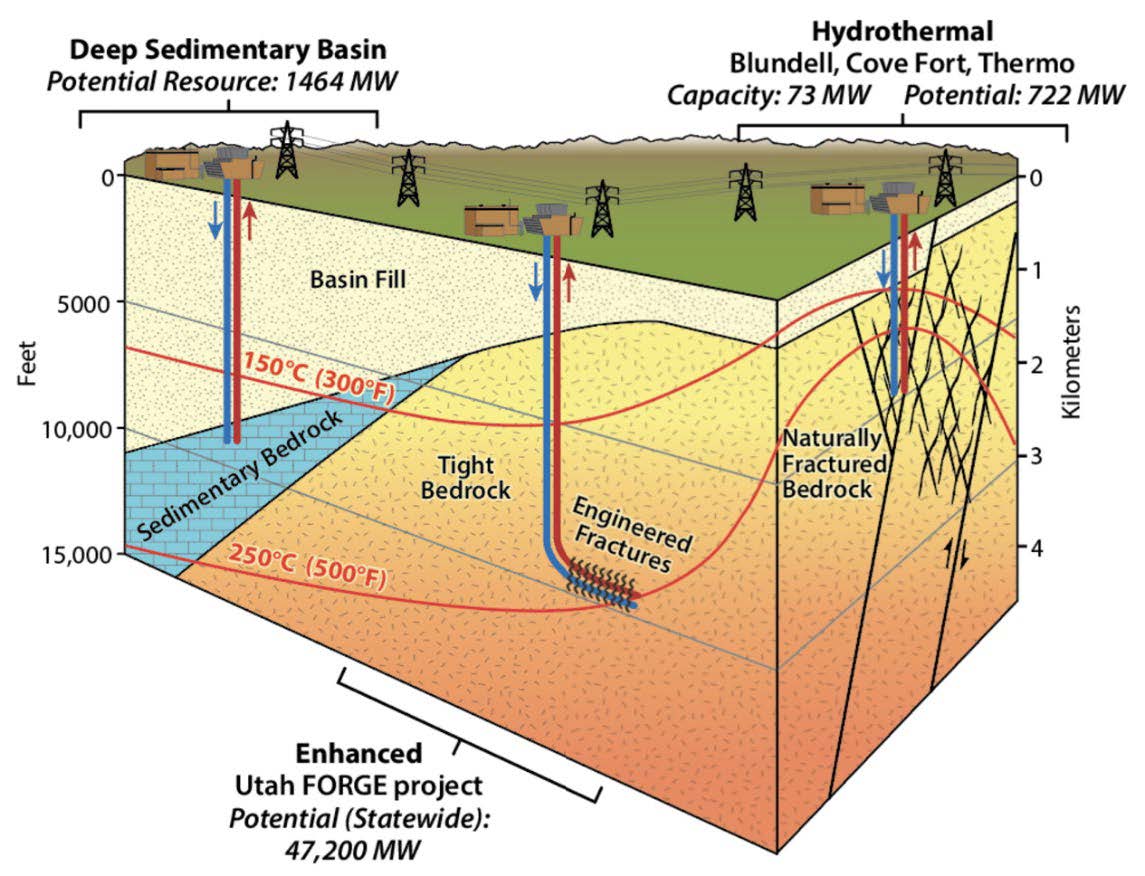
Note. In Utah, enhanced geothermal systems (EGS) are needed to access over 95% of Utah’s geothermal energy. MW = megawatt.
Environmental Considerations for Geothermal Energy Development
Geothermal energy development opens opportunities but also raises questions about water consumption and other environmental impacts. Because future development of geothermal energy in Utah will largely use EGS methods, we focus below on the environmental impacts of EGS for geothermal power production (Szymanski & Hardwick, 2025).
Water Consumption
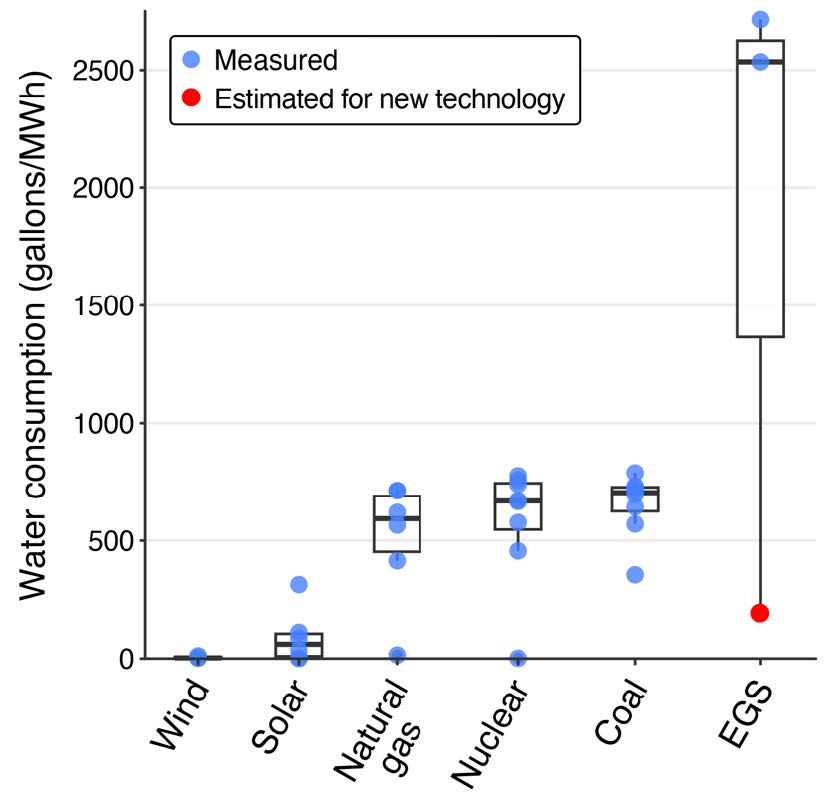
Water consumption by power plants varies depending on the energy source and cooling system (Figure 3). Generating electricity from wind and solar power consumes the least water, followed by natural gas, nuclear energy, and coal. The lowest water consumption rates for nuclear and natural gas power plants are for facilities that use dry and/or hybrid cooling systems (U.S. EIA, 2018). Water consumption by recently tested EGS power plants is comparatively high, but Fervo Energy anticipates lowering water consumption substantially as they continue to refine their technology.
To minimize water consumption, Fervo Energy uses binary cycle power plants, where hot water is brought up from the subsurface, and the heat is transferred to a separate working fluid that is vaporized and spins a turbine. This working fluid is then condensed and reused, rather than evaporated and lost (U.S. DOE, 2019). Fervo Energy also does not use fresh water at its EGS power plants, unlike coal and natural gas power plants in Utah (U.S. EIA, 2025b). Instead, Fervo Energy drills wells up to 2,500 feet deep, far below typical freshwater well depths, to obtain brackish water that is too salty for agriculture or municipal use (Fervo Energy, 2025). However, consuming large amounts of water from deep sources could still affect the structural stability of the aquifers and the water table over time, making low water consumption a top priority (Utah Geological Survey, n.d.).
Water consumption by EGS binary cycle power plants occurs at two points during the project’s life cycle (Fervo Energy, 2025): (1) Construction (one-time use) and (2) operation (continuous use).
Construction
Power plant construction accounts for 1%–8% of total EGS water consumption (Fervo Energy, 2025). Construction includes drilling wells and stimulating them by injecting large volumes of water or other fluids at high pressure to fracture hot rock and create a subsurface reservoir for fluid circulation. Stimulation is typically a one-time event but can require millions of gallons of water. Over the 30-year lifespan of an EGS well, Fervo Energy estimates that drilling and reservoir stimulation would consume about 15 gallons of water per megawatt-hour (MWh) of electricity generated.
Operation
Power plant operation accounts for 92%–99% of total EGS water consumption (Fervo Energy, 2025). During operation, continuous fluid circulation is required to sustain heat transfer and maintain pressure within the engineered reservoir. Water that seeps out of the reservoir or that is lost during circulation must be replaced. Recent tests at two EGS facilities, Project Red in Nevada and the Frontier Observatory for Research in Geothermal Energy (FORGE) laboratory in Utah, had 10%–20% and 14% water loss, respectively (Fervo Energy, 2025). We report water consumption at EGS power plants based on these results (Figure 3). However, those results were based on 37- and 30-day tests, and the amount of water lost would be expected to decrease as the reservoir becomes pressurized and saturated with water. Fervo Energy also plans to reduce water loss by using a more efficient type of well. The company posits that longer testing windows and their more efficient well type will reduce water loss to below 1%, yielding a total water consumption rate of 195 gallons/MWh (Figure 3, red dot). This would make water consumption by EGS power plants lower than other potential sources of baseload or dispatchable electricity that do not use dry or hybrid cooling systems.
Induced Seismicity
Induced seismicity—earthquakes caused by human activity—can result from oil and gas extraction as well as EGS (Moein, 2023). In the United States, earthquakes caused by oil and gas operations are primarily due to wastewater disposal, not the use of fluid to fracture rock (Rubinstein & Mahani, 2015). Since EGS just uses fluid to fracture rock but does not generate wastewater that requires disposal, its overall risk of induced seismicity is lower compared to oil and gas operations.
Since EGS does not generate
wastewater that requires disposal, its
risk of induced seismicity is lower
compared to oil and gas operations.
In EGS, induced seismicity is most likely to occur during stimulation to form the reservoir (Zhou et al., 2024). This process intentionally creates or reactivates fractures, but the rapid changes in fluid pressure and stress can also trigger small earthquakes along preexisting faults. While most of these events are too small to be felt at the surface, some EGS projects have induced larger events that, in some cases, halted operations (Zhou et al., 2024). Managing induced seismicity is important to ensure that geothermal energy development is safe and sustainable.
The U.S. Department of Energy provides a framework for managing induced seismicity that is built on thorough site assessment, real-time seismic monitoring, and operational response protocols (Majer et al., 2012). Best practices include identifying nearby fault zones before stimulation, using dense seismic networks to detect microearthquakes as they occur, and applying a “traffic light system” that adjusts or halts injection if seismic activity exceeds certain thresholds (Zhou et al., 2024). At Fervo Energy’s Cape Station EGS project in Beaver County, Utah, 17 third-party seismometers are in place as well as six seismometers that belong to the company (Fervo Energy, 2024). Some of these are on the surface, and others are hundreds of feet below ground. Earthquakes above a 2.0 magnitude trigger a pause in operations and potential adjustments. Fervo Energy immediately notifies local stakeholders if any earthquake exceeds a 3.0 magnitude. In addition to promoting safety, monitoring fine-scale seismic activity can help confirm successful creation of fracture networks during stimulation (Li et al., 2024).
Impacts on Ecosystems and Wildlife
Establishing power plants often entails clearing vegetation and building infrastructure that can fragment habitats and disrupt wildlife (International Association for Impact Assessment, 2024). However, for the amount of electricity produced, EGS facilities have a relatively small footprint––well below wind and solar and comparable to coal, natural gas, and nuclear power plants (Table 1; Mai et al., 2025).
Table 1. Land Area Needed to Produce 1 Megawatt (MW) of Electricity for Energy Sources in the United States
| Energy source | Acres needed to produce 1 MW of electricity |
|---|---|
| Coal | 1.9 |
| Enhanced geothermal system (EGS) | 2.0 |
| Natural gas | 2.0 |
| Nuclear | 2.4 |
| Solar | 19.0 |
| Wind | 37.4 |
Data sources: Bolinger & Bolinger, 2022; Enevoldsen & Jacobson, 2021; Lawrence Berkeley National Laboratory, 2025; Mallah et al., 2025; Stevens et al., 2017
Conclusion
Geothermal energy has the potential to transform Utah’s electricity landscape, driving a future with improved air quality, lower carbon emissions, and fewer environmental impacts. As of March 2025, EGS power plants in Utah could offer baseload or dispatchable electricity while emitting little to no air pollution and carbon dioxide, consuming very little fresh water, posing minimal earthquake risk, and using just a small amount of land.
New techniques being developed by Fervo Energy are aiming to reduce the amount of brackish water that EGS power plants consume to less than half the amount of fresh water that most of Utah’s coal and natural gas power plants consume (Figure 3). Furthermore, other companies (e.g., Rodatherm) are exploring closed-loop geothermal systems that would largely eliminate water consumption (LaBonty et al., 2026). Taken together, developing Utah’s plentiful geothermal resources could meaningfully reduce harmful emissions and support an energy system that balances electricity production with environmental stewardship.
Acknowledgments
This publication was produced as part of the Climate Adaptation Intern Program (CAIP) at Utah State University. CAIP was supported by the “Secure Water Future” project, funded by an Agriculture and Food Research Initiative Competitive Grant (#2021-69012-35916) from the U.S. Department of Agriculture (USDA) National Institute of Food and Agriculture, as well as the USGS Southwest Climate Adaptation Science Center (#G24AC00611). CAIP is also supported by the Utah Climate Workforce Fund, USU Extension, and the USU Extension Water Initiative. We improved this fact sheet based on feedback from CAIP participants.
The authors did not use generative AI in creating this content, and it is solely the work of the authors.
For correspondence, contact Scott Hotaling: scott.hotaling@usu.edu.
References
Aljubran, M. J., & Horne, R. N. (2024). Power supply characterization of baseload and flexible enhanced geothermal systems. Scientific Reports, 14(1), 17619. https://www.nature.com/articles/s41598-024-68580-8
Anderson, T. C. (2013). Geothermal potential of deep sedimentary basins in the United States. Energy and Geoscience Institute. https://publications.mygeoenergynow.org/grc/1030573.pdf
Bolinger, M., & Bolinger, G. (2022). Land requirements for utility-scale PV: An empirical update on power energy density. IEEE Journal of Photovoltaics 12(2), 589–594. https://doi.org/10.1109/JPHOTOV.2021.3136805
Cape Station. (2025). Insights on seismic behavior at Cape Station 2025. https://capestation.com/insights-on-seismic-behavior-at-cape-station-2025/
Deo, M., Setoyama, E., Sieving, J., & Henning, M. (2023). Water for power study: Final report – February 2023. University of Utah Energy and Geosciences Institute. https://le.utah.gov/interim/2023/pdf/00003401.pdf
Enevoldsen, P., & Jacobson, M. Z. (2021). Data investigation of installed and output power densities of onshore and offshore wind turbines worldwide. Energy for Sustainable Development 60, 40–51. https://doi.org/10.1016/j.esd.2020.11.004
Fervo Energy. (2024). Fervo’s approach to induced seismicity management. https://fervoenergy.com/fervos-approach-to-induced-seismicity-management/
Fervo Energy. (2025). Geothermal mythbusting: Water use and impacts. https://fervoenergy.com/geothermal-mythbusting-water-use-and-impacts/#68ba15e1-7aef-4b32-9aa2-30542ee9a825-link
Horne, R., Genter, A., McClure, M., Ellsworth, W., Norbeck, J., & Schill, E. (2025). Enhanced geothermal systems for clean firm energy generation. Nature Reviews Clean Technology, 1(2), 148–160. https://doi.org/10.1038/s44359-024-00019-9
International Association for Impact Assessment. (2024). Chapter 9: Geothermal power. https://training.iaia.org/chapter-9-geothermal-power/
LaBonty, E., Becker, K., Mitchell, L., Bodine, J., & Hotaling, S. (2026). Geothermal energy in Utah: Massive potential to meet growing electricity needs [Fact sheet]. Utah State University Extension.
Lawrence Berkeley National Laboratory. (2025). PV capacity factors. https://emp.lbl.gov/pv-capacity-factors
Li, D., Huang, L., Li, Y., Zheng, Y., & Moore, J. (2024). Seismic monitoring of EGS fracture stimulations at Utah FORGE (Part 1): Time-lapse variations of b-values and shear-wave splitting rates of induced microearthquakes. Geothermics, 120, 103005. https://www.sciencedirect.com/science/article/abs/pii/S0375650524000944
Mai, T., Lopez, A., Marquis, M., Gleason, M., Hamilton, A., Trainor-Guitton, W., Ho, J., & Sharma, S. (2025). Land of opportunity: Potential for renewable energy on federal lands [Report No. NREL/TP-6A40-91848]. National Renewable Energy Laboratory. https://www.nrel.gov/docs/fy25osti/91848.pdf
Majer, E., Nelson, J., Robertson-Tait, A., Savy, J., & Wong, I. (2012). Protocol for addressing induced seismicity associated with enhanced geothermal systems. U.S. Department of Energy. https://www1.eere.energy.gov/geothermal/pdfs/geothermal_seismicity_protocol_012012.pdf
Mallah, E., Smith, A., Ghadanfar, N., & Latimer, T. (2025). Scaling 24/7 power for the AI era: The enhanced geothermal data center corridor. https://fervoenergy.com/wp-content/uploads/2025/07/Fervo_UIPA_The-Enhanced-Geothermal-Data-Center-Corridor_July-2025.pdf
Moein, M. J. A., Langenbruch, C., Schultz, R., Grigoli, F., Ellsworth, W. L., Wang, R., Rinaldi, A. P., & Shapiro, S. (2023). The physical mechanisms of induced earthquakes. Nature Reviews Earth & Environment, 4, 847–863. https://doi.org/10.1038/s43017-023-00497-8
Rubinstein, J. L., & Mahani, A. B. (2015). Myths and facts on wastewater injection, hydraulic fracturing, enhanced oil recovery, and induced seismicity. Seismological Research Letters, 86(4), 1060–1067. https://doi.org/10.1785/0220150067
Stevens, L., Anderson, B., Cowan, C., Colton, K., & Johnson, D. (2017). The footprint of energy: Land use of U.S. electricity production. Strata. https://docs.wind-watch.org/US-footprints-Strata-2017.pdf
Szymanski, E., & Hardwick, C. (2025). Resurging interest in Utah’s geothermal energy resources. Utah Geological Survey. https://geology.utah.gov/map-pub/survey-notes/resurging-interest-in-utahs-geothermal-energy-resources/
U.S. Department of Energy (DOE). (2019). GeoVision: Harnessing the heat beneath our feet. https://www.energy.gov/sites/default/files/2019/06/f63/GeoVision-full-report-opt.pdf
U.S. Department of Energy (DOE). (n.d.-a). Geothermal basics. https://www.energy.gov/eere/geothermal/geothermal-basics
U.S. Department of Energy (DOE). (n.d.-b). Hydrothermal resources. https://www.energy.gov/eere/geothermal/hydrothermal-resources
U.S. Department of Energy (DOE). (n.d.-c). Enhanced geothermal system. https://www.energy.gov/eere/geothermal/enhanced-geothermal-systems
U.S. Energy Information Administration (EIA). (2018). Some U.S. electricity plants use dry cooling. https://www.eia.gov/todayinenergy/detail.php?id=36773
U.S. Energy Information Administration (EIA). (2025a). Utah electricity profile 2024: Table 5. https://www.eia.gov/electricity/state/utah/
U.S. Energy Information Administration (EIA). (2025b). Thermoelectric cooling water data: 2024 water cooling by generator and boiler – summary. https://www.eia.gov/electricity/data/water/
Utah Division of Air Quality. (2023). Utah’s air quality 2023 annual report. Utah Department of Environmental Quality. https://www.utah.gov/pmn/files/1107891.pdf
Utah Geological Survey. (n.d.). Groundwater levels. https://geology.utah.gov/water/groundwater/groundwater-levels/
Utah Public Service Commission. (2025). RMP appendix G. https://psc.utah.gov/2025/03/31/docket-no-25-035-22/
Zhou, W., Lanza, F., Grigoratos, I., Schultz, R., Cousse, J., Trutnevyte, E., Muntendam‐Bos, A., & Wiemer, S. (2024). Managing induced seismicity risks from enhanced geothermal systems: A good practice guideline. Reviews of Geophysics, 62(4). https://doi.org/10.1029/2024rg000849
June 2026
Utah State University Extension
Authors
Joseph Harding1, Kendall Becker1,2, Logan Mitchell3, Jennifer Bodine3, Scott Hotaling1,2
1 Utah State University (USU) Climate Adaptation Intern Program
2 USU Department of Watershed Sciences
3 Utah Clean Energy

Scott Hotaling
Assistant Professor | Climate Resiliency Specialist
Watershed Sciences
Related Research