
Warming a Calf

Calves born in the winter or spring are often exposed to harsh weather and environmental conditions. After birth, calves may become chilled due to cold temperatures or not being dried off promptly. When calves are cold, you may see them shivering to increase muscle heat production; their body will start to move blood away from the extremities to the core to reduce heat loss. However, a chilled calf may be experiencing hypothermia. There are two types of hypothermia.
Types of Hypothermia
Exposure Hypothermia
- Cause: Exposure hypothermia occurs through gradual heat loss in a cold environment due to respiration, evaporation, inadequate hair coat, body flesh, or weather protection.
- Affected animals: It affects all livestock, especially young, old, and thin animals.
Immersion Hypothermia
- Cause: Immersion hypothermia occurs through rapid heat loss due to a wet, saturated hair coat.
- Common situations with calves include the following:
- Born wet with uterine fluids.
- Born in deep snow or wet ground.
- Falling into a creek or being soaked by heavy snow or rain and experiencing chilling winds.
Depending on the severity of the weather or other environmental factors, calves may experience different degrees of hypothermia, which have different signs and symptoms.
Mild Hypothermia
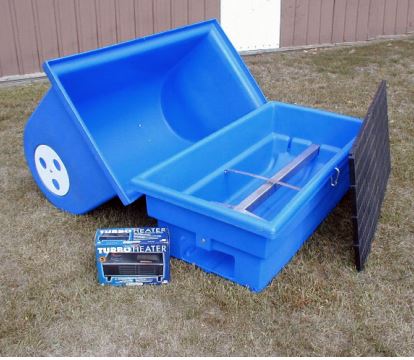
Photo courtesy of Barn World, used with permission
- Core temperature: drops below normal (around 100 °F for beef calves).
- Signs:
- Vigorous shivering.
- Increased pulse and breathing rates.
- Cold nostrils and pale, cold hooves (blood shunted away from extremities).
- Trouble standing and suckling (newborn calves).
- Erratic behavior, confusion, and clumsy gait (referred to as "dummy" calves).
Severe Hypothermia

- Core temperature: drops below 94 °F.
- Signs:
- Continued blood shunting.
- Cold, pale nostrils and hooves.
- Muscle rigidity replaces shivering.
- Slower pulse and respiration as a calf’s temperature drops to 88 °F.
- Vital organs start to cool.
- Impaired brain function—confusion to unconsciousness.
- Below 86 °F:
- Signs of life are hard to detect.
- Dilated and fixed pupils.
- Undetectable pulse.
- Occasional gasps of respiration (4–5 per minute).
- Possible heart failure may cause death.
Watching for these signs and symptoms of hypothermia will determine if you need to take action. Calves experiencing any cold stress, which results in calves not suckling, should be dried and warmed to increase body temperature (Arnold, n.d.).
Methods to Warm a Calf
- Use floorboard heaters in a vehicle.
- Place the calf under a heat lamp.
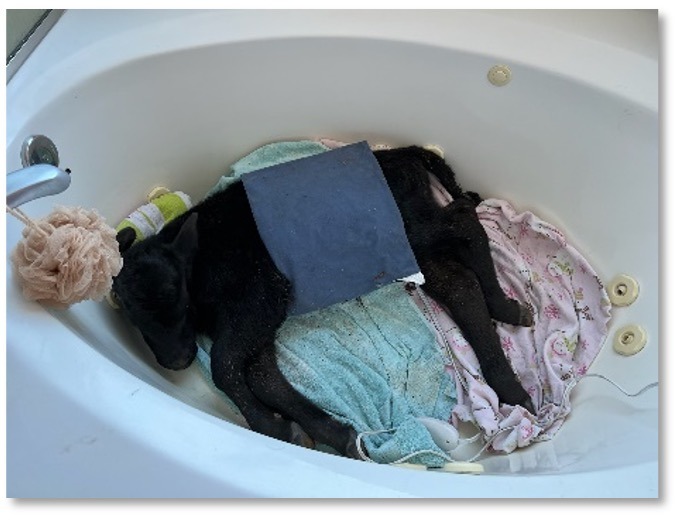
- Provide warm blankets (Figure 1).
- Place the calf in a calf warmer (Figure 2).
- Place the calf next to a heater in the house. (Figure 3).
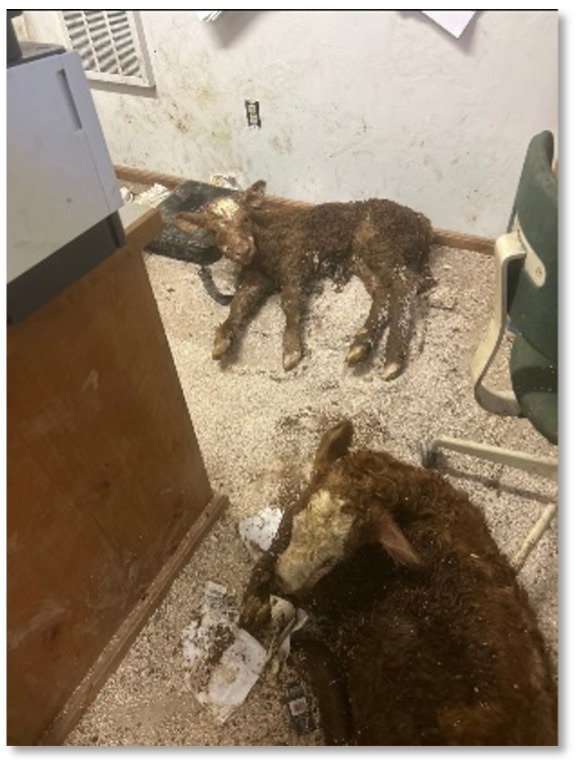
- Move the calf into a warm shop or barn (Figure 4).
- Immerse the calf in warm water.
- Place the calf in a tub of water (100 °F).
- Continuously add warm water to the tub to bring up the calf’s temperature slowly.
Once Warm
- Provide colostrum and maintain body temperatures.
- Colostrum is best supplied by the mother, but there are alternate powdered options.
- Tube-feeding (“tubing”) is usually required in calves born under distress because they lack the vigor to nurse. See the Utah State University Extension fact sheet “Tube Feeding a Calf” (Reid et al., 2025) for more information on proper technique.
- Ideally, a calf should have colostrum within 1 to 2 hours after birth; after 24 hours, the calf’s intestines cannot absorb antibodies (Waechter-Mead, 2022, March 1).
- Once the calf maintains a normal body temperature (101 °F to 102 °F), they can be placed back outside.
Photo Credit
Authors provided all figure photos unless otherwise noted.
References
- Arnold, M. (n.d.). Cold stress and newborn calves. Department of Animal & Food Sciences, University of Kentucky. https://afs.ca.uky.edu/dairy/cold-stress-and-newborn-calves
- Barn World. (n.d.). Calf warmer and heater [Photograph]. https://www.barnworld.com/cattle-guards/?product_link=calf-wamer-with-heaterf7e6e2bd-12ef-46bc-b735-2f1df9195e5e
- Reid, C., Briggs, R., Heaton, M., Esplin, R., & Secrist, D. (2025). Tube-feeding a calf [Fact sheet]. Utah State University Extension.
- Waechter-Mead, L. (2023, February 1). Managing hypothermia in newborn calves. University of Nebraska - Lincoln. https://beef.unl.edu/beefwatch/2023/managing-hypothermia-newborn-calves/
- Waechter-Mead, L. (2022, March 1). How colostrum works, why calves need it, and what to do if they aren’t getting it. University of Nebraska - Lincoln. https://beef.unl.edu/beefwatch/2022/colostrum-101/

May 2025
Utah State University Extension
Peer-reviewed fact sheet
Authors
Cheyenne Reid, Reganne Briggs, Melanie Heaton, Rebekah Esplin, David Secrist

Cheyenne Reid
Extension Assistant Professor | Agriculture, Natural Resources, 4-H | Uintah County Director
Agriculture and Natural Resources

Melanie Heaton
Extension Assistant Professor | Agriculture, Natural Resources | Garfield County Director
Agriculture and Natural Resources

David Secrist
Professor of Professional Practice Beef Cattle Extension Specialist
Animal, Dairy and Veterinary Sciences

Reganne Briggs
Extension Assistant Professor | Agriculture, Natural Resources, 4-H | Rich County Director
Agriculture and Natural Resources

Rebekah Esplin
Professional Practice Extension Assistant Professor | Agriculture and Natural Resources | Iron County
Agriculture and Natural Resources
Related Research