
The Economics of Calving Interval
Introduction
Highlights
- Reproductive efficiency is crucial for ranch profitability.
- Cows that calf early wean heavier calves and have improved herd longevity.
- Track calves born in 21-day periods; aim for ≥60% by day 21, ≥85% by day 42, and ≥95% by day 63.
- First-calf heifers calving early help establish a consistent annual calving interval.
- Body condition at calving significantly impacts rebreeding, especially for heifers; ensure adequate nutrition before and after calving.
- Short-term calf removal (48 hours) can stimulate estrus in cows with good body condition.
- Continuous tracking and attention to calving trends enable timely interventions and support herd reproductive goals.
Reproductive efficiency is a major factor in ranch profitability (Melton, 1995). Cows that calve annually and early in the calving season wean heavier calves and remain in the breeding herd longer than cows that calve later (Damiran et al., 2018). Improved longevity reduces the culling rate and the cost of replacement females. Although individual calving intervals can be monitored, this may be impractical in extensive ranch operations. Tracking the number of calves born in each 21-day period provides a practical herd-level measure. Comparing calving distributions from year to year can reveal trends that managers can address.
Monitoring the Herd
The saying “you can’t manage what you don’t measure” applies to calving distribution. Although individual calving records may be impractical in large herds, counting calves born in each 21-day period provides a useful measure. The first calf born marks the beginning of the first period. Counting calves daily or every other day should be sufficient to approximate the distribution. Johnson and Patterson (2020) recommend the following cumulative benchmarks:
- First 21 days: at least 60% of cows calved.
- By day 42: at least 85% of cows calved.
- By day 63: at least 95% of cows calved.
A higher proportion of early-calving cows is possible. Falling below these benchmarks signals an opportunity for improvement. Record the calving distribution each year, monitor trends, and address problems before they become severe.
Start With the Heifers
Heifers born early in the calving season are more likely to calve early themselves.
Improve future calving distribution by selecting early-born heifers as replacements.
First-calf heifers are a useful starting point for establishing a herd that calves annually within a 365-day interval. First-calf heifers may require as many as 30 additional postpartum days before returning to estrus compared with mature cows (Wiltbank, 1970). Heifers that calve in the first 21 days of the calving season are more likely to calve early in subsequent years and tend to remain in the herd longer than those that calve later (Damiran et al., 2018).
Several management practices can improve a heifer’s chances of conceiving on time after her first calf. Heifers born early in the calving season are more likely to calve early themselves. Age at breeding is one factor, and genetic selection may also contribute (Funston et al., 2012). Selecting early-born heifers as replacements may therefore improve the future calving distribution.
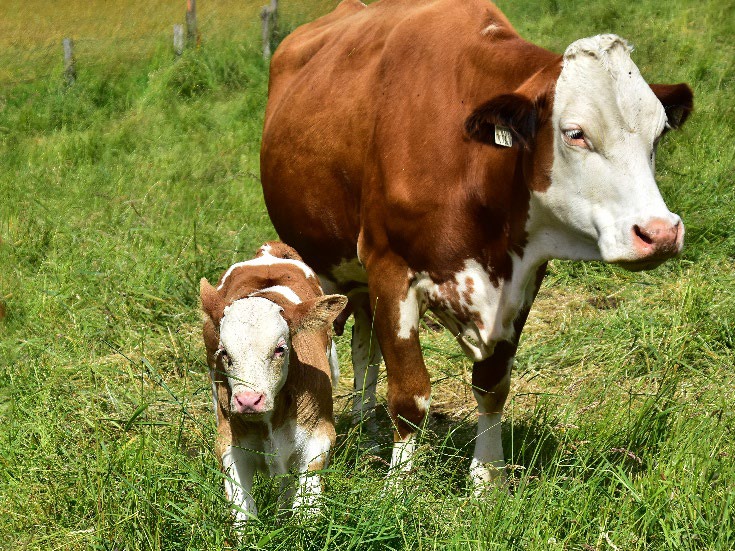
Calving heifers ahead of the mature cow herd gives them more time to resume estrous cycles and conceive during the main breeding season. It also allows labor to focus on heifers during calving. Feed quality and body condition score (BCS) require close attention. Growing heifers have greater nutritional needs, and earlier calving may increase exposure to adverse weather.
Body condition at calving is important for rebreeding, especially in first-calf heifers (Secrist, 2024). In one study, the proportion of heifers pregnant by day 40 of the breeding season was 90% for those calving at BCS 6, compared with 65% at BCS 5 and 43% at BCS 4 (Spitzer et al., 1995). In mature cows, 51% of cows calving at BCS 5 or greater were pregnant by day 20 of the breeding season, compared with 41% of cows at BCS 4 or less; by day 40, the corresponding rates were 79% and 67% (Richards et al., 1986; Secrist, 2024). Adequate nutrition before and after calving helps maintain body condition and a timely calving interval.
Feeding 2-year-old heifers separately from mature cows may be beneficial. Their smaller size can make them less competitive on the feed row, while growth and lactation increase their nutritional needs. Three-year-old cows may also need more nutritional support than older cows. Where ranch logistics permit, consider managing these age groups separately during winter feeding.
Mature Cows
Once a cow has established a late calving date, moving her earlier can be difficult. To maintain a 365-day calving interval, she must conceive again approximately 85 days after calving. Adequate body condition at calving and postpartum nutrition improve the opportunity to rebreed promptly. Management tools may also help selected cows (Berger, 2020).
Short-term calf removal may help initiate estrus in cows with adequate body condition. In this practice, calves are separated for 48 hours and kept in a secure area with feed and water, protection from adverse weather, and dust control. The University of Nevada, Reno Extension fact sheet “Reproductive Management of Beef Cows: 48-Hour Calf Removal” describes this approach.
Combining 48-hour calf removal with a controlled internal drug release (CIDR) progesterone device may further encourage the resumption of estrous cycles. A University of Nevada, Reno Extension fact sheet reports that up to 88% of treated cows were cycling within 4 to 21 days after treatment and calf removal.
Sound nutritional management remains the foundation of reproductive efficiency. Calf removal and progesterone treatment are management options that may help in selected circumstances, but they will not effectively compensate for cows in poor condition (BCS 4 and below).
Value
Table 1 presents Utah calf prices from weekly CattleFax reports supplied to the author for September through November 2025 (CattleFax, 2025). The prices and assumed price slide are inputs to the following illustrative models.
Table 1. Utah Calf Price Assumptions, September–November 2025
| Sex | 550 lb, $/cwt | 450 lb, $/cwt | 350 lb, $/cwt | Slide, $/cwt |
|---|---|---|---|---|
| Steer | $443 | $495 | $537 | $50 |
| Heifer | $409 | $458 | $496 | $50 |
Assuming a common birth weight and daily gains of 2.2 pounds for steers and 1.9 pounds for heifers, Table 2 compares a steer born at the start of the first 21-day period with one born at the start of the fourth period, 63 days later. Both calves are assumed to be weaned and sold on day 210 after the first calf was born. Gross revenue is calculated from the displayed weight and price, then rounded to the nearest dollar.
Table 2. Modeled Value of Steers Born in the First and Fourth Calving Periods
| Calving period | Age at weaning, days | Weaning weight, lb | Price, $/cwt | Gross revenue, $/steer | Advantage, $/steer |
|---|---|---|---|---|---|
| First cycle | 210 | 552 | $442 | $2,440 | $315 |
| Fourth cycle | 147 | 414 | $513.30 | $2,125 | - |
Using the same price and growth assumptions, Table 3 compares a high reproductive efficiency herd (70% of pregnant cows calving in the first 21 days) with a low reproductive efficiency herd (35%). The remaining births were assumed to be distributed evenly across subsequent 21-day periods, with all pregnant cows calving by the midpoint of the fourth period. Both herds were assumed to produce equal numbers of steers and heifers. All calves were weaned and sold on day 210 after the first calf was born. Revenue is expressed per pregnant cow; the model assumes one calf sold per pregnant cow.
Table 3. Modeled Gross Revenue per Pregnant Cow by Calving Distribution
| Herd | Born in first 21 days | Average weaning weight, lb | Gross revenue, $/pregnant cow | Advantage, $/pregnant cow |
|---|---|---|---|---|
| High efficiency | 70% | 492 | $2,117 | $63 |
| Low efficiency | 35% | 462 | $2,054 | - |
Data Conclusions
The model indicates that a steer born at the start of the first calving period generated $315 more gross revenue than one born at the start of the fourth period (Table 2). At the herd level, the high efficiency herd generated $63 more gross revenue per pregnant cow than the low efficiency herd (Table 3). If costs per pregnant cow are assumed equal, the $63 gross revenue difference would also represent a $63 improvement in net return per pregnant cow. Across a herd, that amount could materially affect profitability in years with tighter margins.
This model does not recommend moving the entire calving season earlier in the year. Such a change requires a separate assessment of feed and labor costs, weather risk, and other management considerations. The model instead illustrates the financial advantage of having more cows calve early within an existing calving season.
Summary
Reproductive efficiency includes both the proportion of cows that conceive and when they conceive and calve within the season. Open cows carry a readily identifiable cost and present a clear management decision. A gradual shift toward later calving is less obvious. Its cost may appear as lighter calves at weaning and, if later calving persists from year to year, a greater risk of open cows.
Body condition score is critical to maintaining a timely calving interval and should be monitored beginning at weaning (Secrist, 2024). Maintaining adequate body condition and preventing the herd from drifting toward later calving can provide substantial financial benefits. Early-born replacement heifers also give managers a larger pool from which to select animals likely to calve early in subsequent years.
Acknowledgments
The author did not use generative AI in creating this content; it is solely the author’s work.
References
October 2026
Utah State University Extension
Authors
David Secrist, USU Extension Beef Cattle Specialist

David Secrist
Professor of Professional Practice Beef Cattle Extension Specialist
Animal, Dairy and Veterinary Sciences
Related Research