
Temporary Cattle Identification: Benefits of Marking With Hair Bleach
Why Temporary Identification Matters
Key Takeaways
- Effective temporary identification improves labor efficiency, reduces animal stress, and helps ensure management decisions are applied to the correct animals.
- Using hair bleach provides greater marking longevity when animals must remain identifiable for several months.
- Marking cattle with hair bleach allows producers to sort cattle quickly, improving labor efficiency while reducing handling and stress on both cattle and handlers.
Temporary identification is an important management tool for beef producers. Animals are routinely marked following breeding, pregnancy diagnosis, vaccination, treatment, sorting, shipping, and marketing so they can be quickly identified without repeated handling. Effective temporary identification improves labor efficiency, reduces animal stress, and helps ensure management decisions are applied to the correct animals.
Although branding remains the permanent method of ownership identification and is required for cattle grazing Utah public lands (Utah Department of Agriculture and Food [UDAF], 2023), most producers rely on additional identification methods throughout the production year.
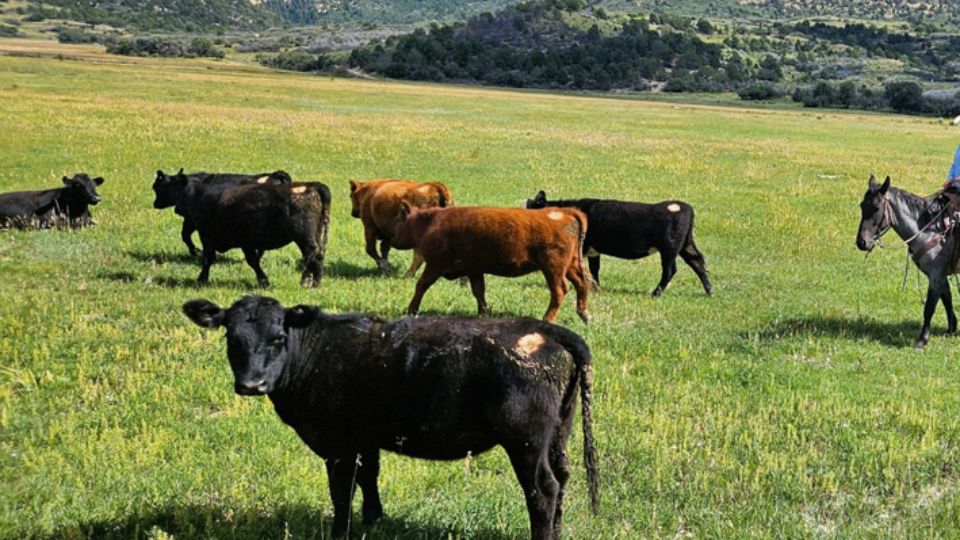
The most appropriate identification method depends on the management objective. Paint markers work well when cattle only need to be identified for a few days or weeks, whereas hair bleach provides greater longevity when animals must remain identifiable for several months (Figure 1).
Choosing the Right Identification Method
No single identification method suits every situation. Producers should select a method based on how long identification is needed, visibility from a distance, cost, and ease of application. Table 1 compares common temporary identification methods.
| Method | Visibility | Longevity | Advantages | Limitations |
|---|---|---|---|---|
| Paint sticks | Excellent | Days to weeks | Fast, inexpensive | Fades quickly |
| Livestock marking paint | Excellent | Several weeks | Easy application | Can wear off |
| Ear tags | Moderate | Years | Individual identification | May be lost or difficult to read |
| Tail paint | Moderate | Days to weeks | Excellent for estrus detection | Primarily designed for heat detection |

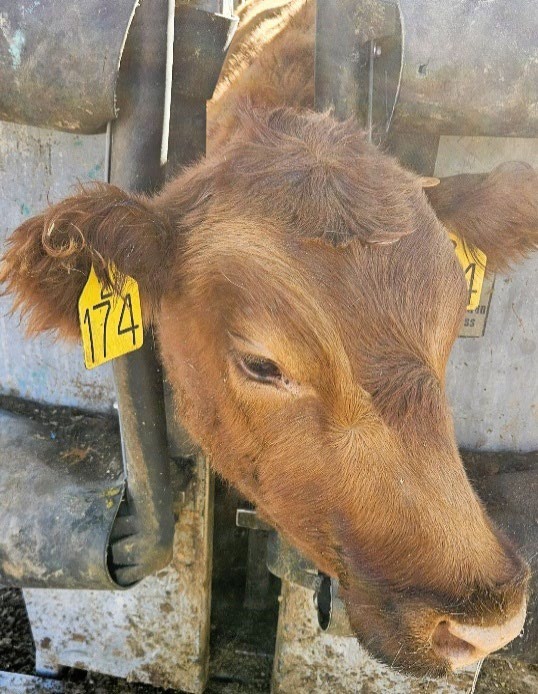
Permanent identification methods include brands, official ear tags, tattoos, and electronic identification (EID). Since November 5, 2024, federal regulations have required electronically readable official ear tags (EID) (Figure 2) for certain classes of cattle moving interstate, including sexually intact cattle and bison over 18 months of age, dairy cattle, and cattle used for shows, exhibitions, or rodeos. Cattle vaccinated for brucellosis must also carry official identification, even if they are not crossing state lines. Existing official metal ear tags applied before the rule took effect remain acceptable forms of official identification. While official identification establishes animal identity for regulatory and traceability purposes, producers often rely on temporary identification methods for day-to-day herd management.
Ear tags (Figure 3) are inexpensive and easy to apply but may be lost or difficult to read from a distance, while tattoos require close handling of the animal (Fernandez, n.d.). Livestock paint sticks and paint markers (Figure 4) are commonly used for short-term identification because they are inexpensive, available in several colors, and can be applied even when cattle are wet. However, these products often fade within days or weeks because of weather and animal activity. When longer-lasting temporary identification is needed, hair bleach provides an effective alternative.
Why Use Hair Bleach?
Western ranchers have used hair bleach successfully for decades because it provides highly visible, inexpensive, non-permanent identification that lasts much longer than conventional livestock markers. Unlike paint, which gradually rubs away, hair bleach lightens the existing hair shaft until it is naturally replaced during seasonal shedding.
Applied correctly, the resulting marks remain visible from horseback, ATVs, or pickup trucks, allowing producers to sort cattle quickly without reading ear tag numbers (Figure 1). This improves labor efficiency while reducing handling and stress on both cattle and handlers.
Hair bleach can be used to identify pregnancy status, breeding groups, vaccination history, treatment groups, calving groups, or animals requiring additional management. Different symbols, numbers, or placement locations allow you to identify multiple management groups simultaneously.
Materials and Availability
Only a few inexpensive supplies are required, including:
- Powdered hair lightener (up to eight levels of lift).
- Crème developer (10-, 20-, or 30-volume).
- Disposable nonpermeable gloves.
- Eye protection.
- Nonreactive mixing container and utensil.
- Paint or salon tint brush.
Powdered hair lightener and crème developer are available through beauty supply stores and online retailers. A 1-pound container of powdered hair lightener and 1 quart of crème developer typically provide enough mixture to mark well over 100 adult cattle, depending on mark size.
Application
- Wear nonpermeable gloves and eye protection throughout mixing and application.
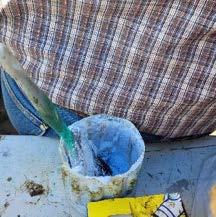
- Mix equal parts powdered hair lightener and crème developer (Figure 5) in a nonreactive container until a smooth, medium-thick paste forms (Figure 6). Prepare only enough mixture to use immediately.
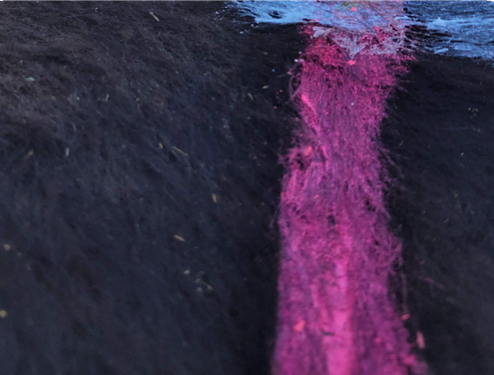
- Apply the paste to clean, dry hair using a paint or tint brush in the desired pattern (Figure 7). The mixture should remain on the hair coat and should not contact bare skin, cuts, eyes, nose, mouth, or other sensitive tissues.

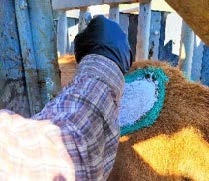
Management Tip
Develop a consistent marking system before processing cattle. For example, use a hip mark for open cows, a tailhead stripe for short-bred cows, and different symbols or locations for treatment groups or calving pastures. Consistent mark placement improves communication among employees and reduces sorting errors.
Safety
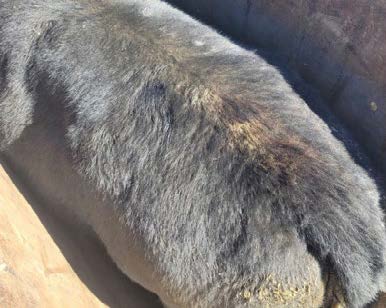
When used properly, hair bleach is a safe temporary identification method. Hydrogen peroxide, the active ingredient in crème developer, decomposes into water and oxygen after exposure to sunlight and becomes inactive once dry (Hunt & Taube, 1952), making rinsing unnecessary.
A veterinary examination conducted after widespread marking of cattle with hydrogen peroxide reported minimal skin irritation and no evidence of eye injury (Pridgeon, 2023).
As with any livestock product, wear appropriate personal protective equipment, avoid application to open wounds or mucous membranes, and apply the mixture only to dry cattle to minimize dripping.
Marketing Considerations
Hair bleach is intended for herd management and may not be appropriate immediately before marketing. Some auction markets report discounted prices or require visibly marked cows to be marketed through a value-based (grid) pricing system, where payment is determined by carcass characteristics rather than competitive live bidding (Stewart, 2022).
If cattle are expected to be marketed soon, producers may instead wish to use ear notches, replacement ear tags, or tail bobbing (trimming the switch or tuft of the tail to create a temporary visual identifier).
Longevity
Hair bleach typically remains visible for several months before fading naturally as the hair coat is replaced during seasonal shedding (Figure 8). Marks are most noticeable on black and dark-colored cattle and are also readily visible on red cattle. White or very light-colored animals generally do not provide sufficient contrast for bleaching to be an effective identification method.
Summary
Temporary identification is an essential component of modern cattle management. While several methods are available, hair bleach provides one of the longest-lasting temporary marking options, offering economical, highly visible identification for several months. When applied properly and incorporated into a herd management program, hair bleach improves sorting efficiency, reduces animal handling, and helps producers make timely management decisions.
References
Acknowledgments
The authors did not use generative AI in creating this content, and it is solely the work of the authors. Author Melanie Heaton provided all the photos in this fact sheet.

September 2026
Utah State University Extension
Peer-reviewed fact sheet
Authors
Melanie Heaton, Reganne Briggs, Rebekah Iverson, Brooke Holgate, and David Secrist

Melanie Heaton
Extension Assistant Professor | Agriculture, Natural Resources | Garfield County Director
Agriculture and Natural Resources

Reganne Briggs
Extension Assistant Professor | Agriculture, Natural Resources, 4-H | Rich County Director
Agriculture and Natural Resources

Brooke Holgate
Professional Practice Extension Assistant Professor | Agriculture and Natural Resources | Duchesne County Director
Agriculture and Natural Resources

David Secrist
Professor of Professional Practice Beef Cattle Extension Specialist
Animal, Dairy and Veterinary Sciences
Related Research