
Water: Your Most Critical Resource
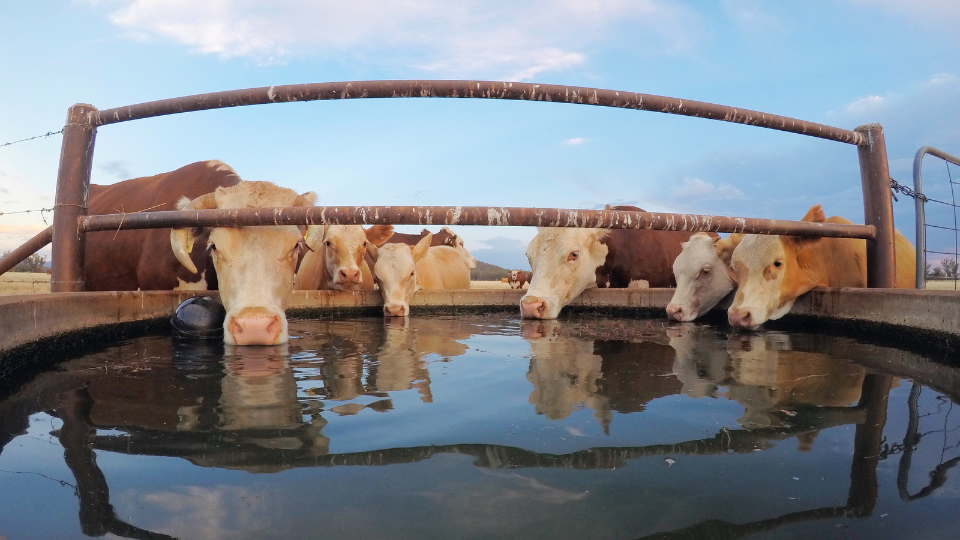
The market setting new highs has become a recurring theme in this article. Market impacts always underscore the importance of sound production practices. With fed cattle markets reaching $2.28 per pound in May, the market continues to defy gravity. Of course, that is excellent news for cow/calf producers as green grass is coming on soon to followed by the heat of summer. Nothing is more critical to your cowherd than water quantity and quality. What can you do to ensure both?
It is easy to take water for granted, but poor water quality and/or availability can adversely affect cattle health and productivity. Water makes up 70% of an animal’s body weight and is essential in digestion, nutrient transport, and temperature regulation. Any disruption in these key body functions will result in reduced feed intake, poor reproductive performance, and health issues in both the cow and her calf.
Cattle can and do travel great distances to water, but what is the cost in terms of production and range utilization? Studies indicate that cattle traveling more than one mile to water in mountainous terrain will have reduced production. Furthermore, range tends to be overutilized close to the water source and underutilized farther away. Water development has the effect of both improving cattle productivity and improving range utilization.
Utah ranchers have an excellent resource in the Utah Department of Agriculture and Food’s (UDAF) Grazing Improvement Program (GIP). The state legislature established GIP to provide cost-share grants for projects that improve rangeland management and sustainability. GIP can partner with livestock producers on both public and private land to improve water infrastructure. More information is available on the UDAF website at ag.utah.gov.
Water quality can also be a big issue. At best, poor water quality can reduce water intake, resulting in poor animal performance. At worst, significant health effects or even death can result from bad water. Under normal, stable conditions, testing your water sources every other year is a good idea. This serves to establish a baseline of “normal” for your operation. Consistent, well and spring water quality likely don’t change drastically from season to season. Some sources of live water and pond/runoff water can change with drought or other weather conditions and should be tested annually.
Quality concerns can include total dissolved solids (TDS), sulfates, iron and nitrates. Additionally blue-green algae can be a problem as water warms and is stagnant. TDS levels below 1,000 ppm are generally considered safe and will not impact production. High sulfates (500 to 1,000 ppm) can reduce absorption of key trace minerals and at higher levels reduce intake. High nitrate levels (300 ppm) can be toxic with levels below 100 ppm generally considered safe for livestock. The bottom line is that it is a good idea to have a regular water testing program. Consult with local extension personnel or your nutritionist on your results. Over time, you can build a database that will help guide your supplementation program and red-flag potential issues.
Best of luck this summer and happy grazing!
Please feel free to reach out anytime.
david.secrist@usu.edu
Contact
David Secrist, PhD
David.secrist@usu.edu