
Drought
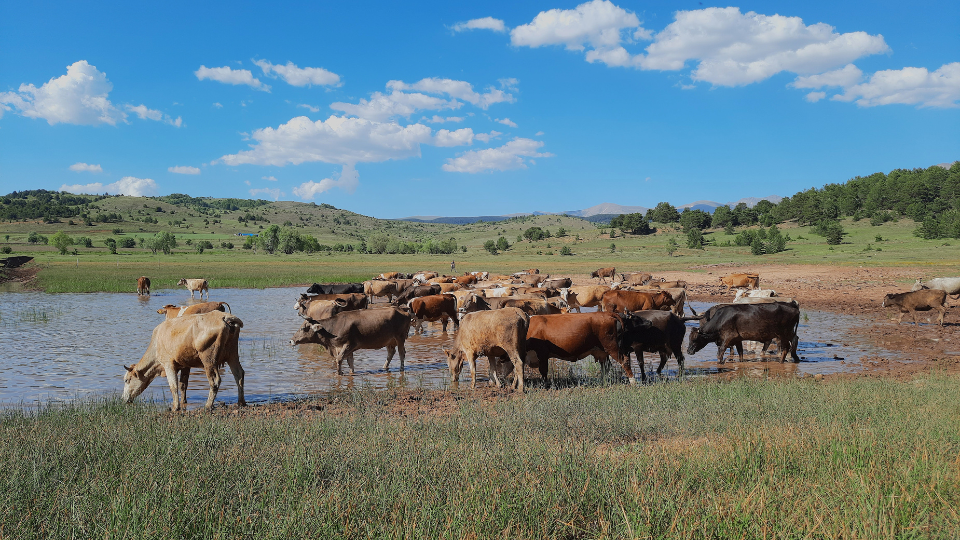
As March turns to April, much of the southern half of Utah is experiencing 50-60% of normal precipitation. Certainly, drought is a fact of life in Utah, but that doesn’t make it any easier to deal with. Spring rains can make big a difference, so all is not lost, but it is time to start thinking about your options if you are in one of the many dry areas of the state.
The latest Seasonal Drought Outlook map (NOAA website) indicates that much of the state will stay dry through the end of May. Fortunately, the cattle market is very strong and will likely remain so. The strong market will help offset some costs incurred if drought impacts your plan this year.
As you consider the alternatives, keep in mind that none are ideal. All will increase cost. However, the goal of a drought plan is to mitigate the negative impact AND protect future productive capability. In other words, don’t allow a one-year problem to become a multi-year disaster for your cowherd or the range. Unfortunately, that is what will happen if you do nothing.
In my estimation, three steps can be taken as you move toward a more severe drought scenario. Each step has different levels and can be used on combination with each other. The order and size of these steps depend on your specific situation. The options are culling, feeding, and early weaning. There isn’t space to develop any of them in detail but I will attempt to give you some ideas.
Lets first discuss culling. If you aren’t currently identifying your cows by age, it’s a good time to start. Cow productivity drops off rapidly around 10 years old and drops off a cliff after 12. If you need to cull, these should be the first to go. I’ll discuss what to do with the calves later.
Does feeding them make sense? Putting some of your cows on feed may make sense if you consider the cost to replace a good cow and the value of the calf she will produce. Remember that protein supplementation doesn’t do much good if your cows don’t have adequate forage. They need energy, which can be challenging to provide in a range situation. You could keep them home and feed hay, but putting them in a feedlot along with their calf may be cheaper in the long run. Feeders have the facilities and access to cheaper by-product feeds that you may not have the ability to handle. It's worth a look.
You may also want to consider grazing hay ground rather than cutting hay. Allowing your cows to do the harvesting and purchasing winter feed is an alternative to consider. Given a choice, reserve the best feed for heifers and young cows. Mature cows may fair well enough in harsh range conditions where younger animals fall apart.
Early weaning seems like a drastic measure, but it has a place and should be considered. A dry cow in good condition eats only 80% of the feed of a wet cow and calf. Weaning at 90 to 150 days will make a big difference in body condition and stocking rate. Weaning before 90 days will also significantly improve reproduction. US MARC data suggests that if calves are removed 8 days before a 42-day breeding season, 28% more cows will be bred. Open cows in the fall is exactly what we are trying to avoid. Nearly as damaging is the cow that slips back in the calving season. Her calf will be nearly 2 pounds lighter for every day she falls back in the next year. Open cows and cows that fall back are the “gift that keeps on giving”. That will cost your operation for years to come.
Caring for early weaned calves can be daunting, especially if they are weaned as early as 90 days. However, it can be done successfully with good attention to detail. You can ask your neighbors in the dairy business all about it. Some excellent feeders in the state can likely help you with the early weaned calves and/or feeding your cows. The University of Nebraska has an excellent article on early weaning that you can access at https://extensionpubs.unl.edu/publication/g2047.
I’ll keep praying for rain, but I hope this is helpful if it stays dry in your country.
Please feel free to reach out anytime.
david.secrist@usu.edu
Contact
David Secrist, PhD
David.secrist@usu.edu