
Beaver Producer Bulletin | August 19, 2026
Cottonwood Fire Water Quality Assessment for Livestock
Following the Cottonwood Fire and subsequent flooding, USU Extension tested water from 12 locations throughout Beaver County to determine whether water quality meets recommended standards for livestock and irrigation.
Summary: Most water measurements were within the laboratory's recommended ranges for livestock. However, some locations showed elevated aluminum, E. coli, and pH results that livestock producers should be aware of.
Water Testing in Beaver County
Chemical testing was conducted by Utah State University's Analytical Laboratory, which compared results with established guidelines for livestock and irrigation water.
E. coli testing was conducted by the Utah Department of Agriculture and Food's regional watershed coordinator in partnership with the Utah Division of Water Quality.
Test Sites
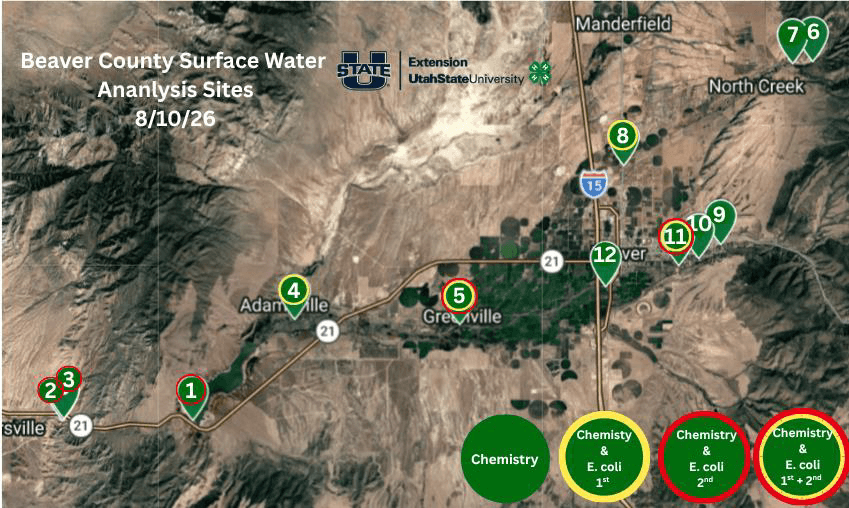
Areas to Watch
Chemical Analysis
Testing conducted July 29, 2026, identified elevated aluminum at two locations. Chemical monitoring is continuing monthly.
| Location | Measure | Result | Livestock Standard |
|---|---|---|---|
| Beaver River 4 | Aluminum | 8.7 mg/L | < 5.0 mg/L |
| North Creek 7 | Aluminum | 5.1 mg/L | < 5.0 mg/L |
E. coli Analysis
Samples were collected August 3 and August 10, 2026. E. coli monitoring is continuing biweekly.
| Location | August 3 | August 10 | Adult Cattle Standard |
|---|---|---|---|
| Beaver River 2 | Not tested | 94.1 MPN/100 mL | < 100 cfu/100 mL |
| Beaver River 4 | 92.4 MPN/100 mL | Site dry - not tested | < 100 cfu/100 mL |
| Beaver River 5 | 559.3 MPN/100 mL | 1,859.6 MPN/100 mL | < 100 cfu/100 mL |
| North Creek 8 | 2,202.9 MPN/100 mL | Site dry - not tested | < 100 cfu/100 mL |
| Beaver River 11 | 1,070.8 MPN/100 mL | 124.15 MPN/100 mL | < 100 cfu/100 mL |
One MPN/100 mL is generally equivalent to one CFU/100 mL. The bulletin lists less than 100 cfu/100 mL as the standard for adult cattle. Less than 1 cfu/100 mL is recommended for juvenile or lactating cattle and other animals.
Recommendation for Areas West of I-15
Producers are encouraged to seek alternate water sources until healthier E. coli levels are observed. If animals are accessing surface waters, watch for diarrhea or other signs of distress.
pH Analysis
Testing conducted July 29, 2026, found the following pH levels.
| Location | pH | Livestock Standard |
|---|---|---|
| Beaver River sites 1, 2, 3 and 11 | 8.0-8.2 | 5.5-8.3 |
| North Creek site 8 | 8.2 | 5.5-8.3 |
| Beaver River sites 9, 10 and 12 | 8.4 | 5.5-8.3 |
Elevated pH can result from wildfire and ash runoff. Animals may avoid drinking water if pH rises above 8.5. The state veterinarian recommends watching animals for dehydration.
Harmful Algal Blooms
Some sites are elevated for phosphorus, which may contribute to the overgrowth of cyanobacteria. Unlike regular algae, this "blue-green algae" can produce toxins that are dangerous or fatal to animals.
Community members are encouraged to watch ponds, reservoirs, and slow-moving water for harmful algal blooms.
If You Suspect a Harmful Algal Bloom
- Keep animals away from the water and avoid touching the suspected material.
- Use a stick to gently scoop the material from the water. Long, green, hair-like strands that attach to the stick are likely harmless filamentous algae.
- If the material stays suspended, does not catch on the stick, or comes up in globs, it may be a harmful algal bloom.
- Take close-up and wider photos and send them with a location pin to rhett.marshall@usu.edu.
The Bottom Line for Producers
Most of the water tested remains within recommended ranges for livestock. There is some concern about elevated aluminum at Beaver River site 4, with the greatest concern involving E. coli levels that exceed established livestock standards.
When possible, alternate water sources are recommended in areas with elevated E. coli counts. These levels may continue to change as waterborne pathogens are flushed downstream.
USU Extension, the Utah Division of Water Quality, and the Utah Department of Agriculture and Food will continue monitoring conditions and sharing information with producers.
Questions?
Contact Rhett Marshall at USU Extension Beaver County.
USU Extension Beaver County
65 N 400 E St
Beaver, UT 84713
(435) 438-6450
rhett.marshall@usu.edu