
Intermountain West Florist Local Cut Flower Sourcing Preferences

Introduction
While California and Florida have the highest cut flower sales in the nation, the industry is expanding in other regions, such as the Intermountain West. Enhanced production and marketing education and information and using season-extension technologies have spurred rapid increases in cut flower farms. For example, in Utah, the number of flower farms rose from 20 to 200 between 2018 to 2023 (Langford et al., 2023). Cut flower growers in the Intermountain West sell their flowers through both direct-to-consumer and wholesale markets, but florists and other wholesale markets often make up a larger part of growers' business as they gain experience (Langford et al., 2024). In 2021, retail florists in the U.S. numbered just over 12,000, making up nearly 20% of all floral industry businesses (National Agricultural Statistics Service [NASS], 2024). With the U.S. floral gift market expected to grow by over 50% by 2028 (Arizton, 2023), understanding the preferences and needs of this important market will be essential for growers looking to enter and thrive in this market.
This fact sheet, the second in a two-part series, outlines a study conducted in January 2024 with florists operating in the Intermountain West. It provides local cut flower growers with pertinent information on florist preferences for sourcing flowers locally. An online Qualtrics survey was conducted in January 2024 with florists in six Intermountain states, including Utah, Idaho, Nevada, Wyoming, Colorado, and Montana. A total of 1,412 florists were invited by email to complete the survey. A total of 205 florists responded to the survey, with 170 valid responses. The survey questions centered on various aspects of florist businesses, including their experience sourcing local flowers from growers and cooperatives, perceived barriers to local sourcing, and their current and projected local flower purchases. Additionally, florists were asked about their current preferences and needs for local cut flowers, including pricing, quantity, variety, and delivery preferences.
Floral Business Overview
A complete overview of the business details of the respondent florists is provided in the first fact sheet in this series (see Curtis et al., 2024). However, respondent florists were generally very experienced, as almost half had been in business for over 10 years. Additionally, their floral businesses were well developed, with 58% having annual sales of more than $100,000 and 36% spending $60,000 or more on flowers annually. Their primary markets were daily florals and weddings. Additionally, florists were well educated, as 57.5% had at least a college degree.
Local Sourcing Experience
As shown in Figure 1, more than half of the florist respondents (53%) reported that they sourced less than 10% of their flowers locally in 2023, and 16% reported that none were sourced locally in the last year. However, when asked what percentage of their flowers they would like to source locally in 2024, more than half (60%) indicated that they would like to source at least 25% of their flowers from local growers. Among those that did source flowers locally in 2023, nearly two-thirds (65%) sourced from five or fewer local growers. Only one respondent reported sourcing flowers from more than ten local growers. In 2023, 23% of those who reported sourcing local flowers used cut flower cooperatives.
Figure 1. Local Cut Flower Sourcing 2023 Actual vs. 2024 Desired
Florists who did not source locally in 2023 were asked about their reasons. The most common response was that local flowers were not available nearby. The second most common response was that they didn't know where to find locally grown cut flowers. Only five respondents reported their reasons for not wishing to use local flowers in 2024. Among these few, the primary rationales appear to be limited availability and cost.
Local Sourcing Disadvantages
Florists described their experience sourcing from local flower cooperatives, including any advantages or disadvantages. Florists reported limited supply as the highest disadvantage, citing insufficient flowers to meet their needs. This concern is compounded by florists' frustrations with poor reliability and cooperative inability to guarantee in advance what flowers would be available. Additionally, florists commonly reported that the short seasonal availability and unpredictable weather in the Intermountain West pose challenges when sourcing flowers through local cooperatives. Florists also expressed frustration about the lack of delivery services or inconvenient pick-up times that made it difficult for them to use local cooperatives. Furthermore, florists mentioned price as an advantage of local cooperatives nearly as often as it was a disadvantage. This suggests that while some florists find the cost a barrier to sourcing local flowers through cooperatives, others feel that flower prices at cooperatives are reasonable.
Most of the respondent florists (80%) reported that delivery capabilities were a barrier to sourcing local cut flowers (see Figure 2). More than half of the respondents also identified limited inventory or supply (59%) and lack of the needed flower varieties (50%) as obstacles to sourcing locally grown cut flowers. Seasonality, pricing, and travel time to pick up were also selected by more than 40% of respondents.
Figure 2. Barriers to Sourcing Local Cut Flowers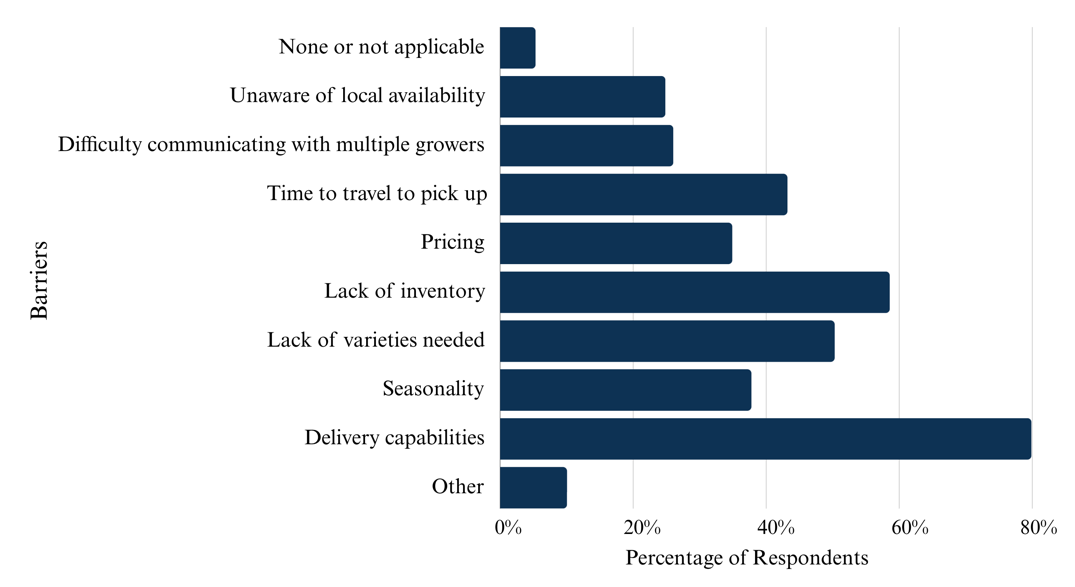
Reasons to Discontinue Local Sourcing
Florists who had previously sourced locally but stopped were asked to explain what prompted them to discontinue sourcing locally grown cut flowers. The most common reason the florists gave for discontinuing local sourcing was the seasonality of local cut flowers. These same florists cited high prices as the second most common reason for discontinuing local sourcing. Florists also mentioned the convenience of buying from wholesalers. They noted that wholesalers offer delivery, provide large consistent volumes of flowers year-round, and offer many varieties from one source, whereas local growers cannot provide these services.
Local Sourcing Advantages
When florists were asked if the availability of local flowers had benefited their business, the majority (64%) indicated that it had. Additionally, when florists were asked to indicate the benefits of sourcing local flowers (see Figure 3), the most common response (82%) was that local sourcing helps support their local economy. More than two-thirds of the respondents also identified the unique selection available (70%), the improved quality or vase life of local flowers (62%), and the reliable supply from local growers. Florists indicated that one of the primary benefits to sourcing local flowers was the "marketing value" to customers, although a few florists claimed that customers couldn't tell the difference between local and imported flowers. Dahlias were specifically recognized as higher quality from local growers, along with sunflowers.
Figure 3. Local Cut Flower Sourcing Benefits
Local Sourcing Preferences
Over half of the florists (60%) reported that they would like to source at least 25% of their flowers locally in the coming year. When asked about the minimum number of bunches per flower variety they would need each week (see Table 1), more than half of the respondents (58%) indicated that they would need 10 bunches or fewer per flower variety to meet their quantity needs. Another 25% indicated they would require 11-20 bunches per flower weekly. Although a lack of delivery services was reported as a barrier to sourcing local flowers, nearly half (47%) of the surveyed florists indicated they would require only one delivery a week, and a further 44% reported that they would need flower deliveries only twice a week.
Pricing Preferences
Regarding pricing, almost half (49%) of the florist respondents were willing to pay 5% or less over wholesale pricing for locally grown cut flowers. A third were willing to pay from 6%-10% more for local flowers, and 16% were willing to pay from 11%-20% over wholesale pricing. This suggests that many florists understand the quality benefits of local sourcing but are also price sensitive.
Availability Preferences
While the Intermountain West faces challenges such as a short growing season and unpredictable weather affecting flower availability, half of the respondents (50%) indicated the need for at least five days' notice regarding the variety and quantity of available flowers. More than a quarter (28%) reported they would require more than 10 days' notice. When asked about what time of year they most needed local cut flowers, 44% of respondent florists indicated a demand throughout the entire year. Additionally, the most common "other" response was that they would prefer to have local flowers all year, but they recognize that the growing season is short. These responses suggest that though there are peaks in floral sales, florists' need for cut flowers is relatively consistent, and growers may be better able to serve florists by using season-extension methods to grow earlier in the spring and later in the fall.
Table 1. Local Cut Flower Preferences
|
Question description |
Category |
Sample (%) |
|---|---|---|
|
Would you be willing to pay more |
None 5% or less 6% to 10% 11% to 20% More than 20% |
23% 26% 33% 16% 2% |
|
What do you feel are |
None Quality - vase life Quality - event ready Unique selection Reliable supply Promotional - local economy Promotional - sustainable production Other |
2% 62% 40% 70% 15% 82% 53% 12% |
|
What is the minimum |
1 or less 2 to 5 6 to 10 11 to 15 16 to 20 More than 20 |
10% 27% 22% 10% 15% 16% |
|
How much advanced notice |
1 day or less 2 to 3 days 4 to 5 days 6 to 10 days More than 10 days |
7% 26% 17% 22% 28% |
|
What time of year are you |
Only for early season holidays Only for late season holidays One or two months in the summer All summer long All year long Other |
4% 0% 2% 38% 45% 11% |
Flower Variety Preferences
The respondent florists indicated a wide range of flower varieties they would prefer from local growers (see Figure 4). Peonies were the most popular flower, with 92% of the respondents indicating they would prefer peonies. Dahlias (88%), ranunculus (85%), and lisianthus (80%) were all preferred from local growers by more than 80% of the respondents. Of the 28 different flower varieties listed, 20 varieties were selected by more than 50% of respondents. These results suggest that though some varieties (such as peonies and dahlias) may be more popular, florists are interested in a diverse array of locally grown cut flowers.
When asked about their preferred varieties of dried flowers from local growers, more than half of the respondents (55%) selected strawflowers. Many of the "other" responses indicated that they did not use dried floral products or were not interested in sourcing these products locally. This pattern repeated when florists were asked what dried flower colors would be most useful to them; here, the majority reported that they do not use dried products. Among the florists that do use dried flowers, the most popular colors were neutrals, including white or cream, as well as bleached flowers. Pink was also commonly reported.
Respondent florists were asked to describe the advantages of sourcing their flowers through a local cooperative. Flower quality was identified as the highest-ranked advantage, with some respondents specifically highlighting that locally grown dahlias were of superior quality compared to those available from wholesalers. Though six respondents felt that the quality of the flowers sourced through cooperatives was inferior, 31 respondents felt the quality of flowers was an advantage to working with cooperatives. A similar pattern emerged regarding vase life and flower freshness. While some respondents felt vase life as a disadvantage of cooperative flowers, nearly6 times as many respondents considered the extended vase life of cooperative flowers to be a significant incentive for purchasing them. Likewise, nearly twice as many florists (19) reported the selection of flower varieties available was an advantage compared to those that felt the selection was a disadvantage (10). Another frequently reported benefit of sourcing through cooperatives was that they can benefit the local economy, and they are easier to use than sourcing from many individual cut flower farms.
Grower Cooperative Sourcing

Respondent florists were asked to describe the advantages of sourcing their flowers through a local cooperative. Flower quality was identified as the highest-ranked advantage, with some respondents specifically highlighting that locally grown dahlias were of superior quality compared to those available from wholesalers. Though six respondents felt that the quality of the flowers sourced through cooperatives was inferior, 31 respondents felt the quality of flowers was an advantage to working with cooperatives. A similar pattern emerged regarding vase life and flower freshness. While some respondents felt vase life as a disadvantage of cooperative flowers, nearly 6 times as many respondents considered the extended vase life of cooperative flowers to be a significant incentive for purchasing them. Likewise, nearly twice as many florists (19) reported the selection of flower varieties available was an advantage compared to those that felt the selection was a disadvantage (10). Another frequently reported benefit of sourcing through cooperatives was that they can benefit the local economy, and they are easier to use than sourcing from many individual cut flower farms.
Florist Suggestions for Growers
- Competitive pricing. The survey asked respondents for suggestions for cut flower growers interested in serving the florist market. The most frequent recommendation was to price flowers similar to wholesale so that sourcing locally was a financially viable option. A few florists expressed frustration with growers undercutting or competing with them by selling flowers directly to consumers and suggested that growers use different wholesale and direct-to-consumer prices.
- Availability forecasting and delivery. Florists suggested that growers improve ordering processes and provide availability information through a website or weekly email featuring pictures of flowers and their quantities. Some florists expressed interest in knowing flower availability further in advance, preferring a forecast of anticipated availability from the start of the season. Florists noted that delivery services would make sourcing local flowers easier, with some respondents stressing the importance of using climate-controlled trucks and postharvest practices to maintain flower quality during transit.
- Varieties to grow. As for varieties to grow, suggestions from florists varied. Some wanted very unique offerings from local growers that they couldn't find elsewhere, while others recommended focusing on varieties most commonly used by florists. Many florists wanted greater quantities from local growers, so it may be beneficial for growers to focus on a few varieties that they grow well and produce larger volumes to meet the demands of florist customers. For growers unable to independently meet the volume requirements of florists, joining grower cooperatives or collectives may be a useful option.
Conclusions

Flower quality was identified as a major challenge when sourcing cut flowers from wholesale suppliers, but flower quality was repeatedly reported as a benefit of sourcing flowers locally. Florists also noted vase life as both a disadvantage of flowers sourced from wholesalers and an advantage of locally grown flowers. Therefore, both quality and vase life may be major selling points for growers looking to work with florists as these characteristics are commonly recognized by florists and would address the challenges they face when sourcing from wholesalers.
The most common reason florists cited for not sourcing from local growers was the unavailability of local flowers nearby or a lack of knowledge about where to find them. In response, cut flower growers may benefit from increased promotion to florists, informing them about the availability of locally grown cut flowers in their area.
Convenience and quantity or availability repeatedly appeared across the survey responses regarding disadvantages and obstacles to sourcing locally grown cut flowers for florists. Florists want convenient pick-up times or delivery options and easy ordering with options to see flowers and available quantities before ordering. By making the process easier for florists, growers can remove obstacles to local sourcing and entice more florists to source locally. The concerns around quantity may be addressed by growing higher quantities of fewer varieties or working with other growers or cooperatives to meet florists' quantity needs.
Price was mentioned throughout the responses as a challenge to sourcing flowers from wholesalers, cooperatives, and local growers. The majority of surveyed florists were not willing to pay more than 10% over wholesale pricing, but many also recognized that supporting other local businesses is beneficial for the community's economy. Growers looking to work with florists may benefit from comparing wholesale prices and their farm's operating budget to determine flower prices that florists are willing to pay that are financially sustainable for their farm.
Dahlias were repeatedly called out for being of superior quality from local growers compared to wholesale, but florists also expressed interest in a wide range of cut flower varieties. Colors were similarly varied, though there was an emphasis on bridal colors for wedding florals. There may be no specific variety or color that is in highest demand, so cut flower growers may benefit from considering what plants grow best in their climate and talking with the florists they serve to determine what flowers to focus on.
Acknowledgments
Support for this material was made in part by Utah State University (USU) Extension and by the National Institute of Food and Agriculture, U.S. Department of Agriculture, under award number 2022-38640-37490-WS3SI through the Western Sustainable Agriculture Research and Education program under project number WPDP23-008. USDA is an equal opportunity employer and service provider. Any opinions, findings, conclusions, or recommendations expressed in this publication are those of the author(s) and do not necessarily reflect the view of the U.S. Department of Agriculture.
References
- Arizton. (2023). U.S. floral gifting market - industry outlook and forecast 2023-2028. https://www.arizton.com/market-reports/floral-gifting-market-in-united-states-2025
- Cain, S. (2022, February 2). Where have all the flowers gone? The New York Times. https://www.nytimes.com/2022/02/02/style/flower-supply-shortage.html
- Curtis, K., Langford, M., Stock, M., Wagner, K., Reid, C., Xiong, V., & Zesiger. C. (2024). Intermountain West florist market overview and outlook [Fact sheet]. Utah State University Extension. https://extension.usu.edu/apec/research/cut-flower-industry
- Curtis, K. R., & Stock, M. (2023). Research report: Growing a new cut flower industry: Market needs and preferences. Journal of Food Distribution Research, 54(1), 1-7.
- Darras, A. (2021). Overview of the dynamic role of specialty cut flowers in the international cut flower market. Horticulturae, 7(3), 51. https://doi.org/10.3390/horticulturae7030051
- Fitzgerald, K. (2018, February 27). Edible garden - flowers. Edible Reno-Tahoe. https://ediblerenotahoe.com/editions/summer2018/summer2018-edible-garden-flowers/
- Ford, T., Kime, L., Harper, J. K., & Bogash, S. (2012, December 17). Cut flower production [Fact sheet]. Penn State Extension. https://extension.psu.edu/cut-flower-production
- Knoch, J. (2022). BLOOM BOOM: We're putting more thought into where our food comes from, but what about our blooms? Look inside the gorgeous, growing, female-led slow flowers revolution. Chatelaine, 95(5), 32-38.
- Langford, M., Curtis, K., & Stock, M. (2023). An overview of the cut flower industry [Fact sheet]. Utah State University Extension. https://extension.usu.edu/apec/research/cut-flower-industry
- National Agricultural Statistics Service (NASS). (2024). 2023 floriculture crops. NASS Highlights, U.S. Department of Agriculture. https://www.nass.usda.gov/Publications/Highlights/2024/2023-floriculture-highlights.pdf
- Oppenheim, P. P. (1996). Understanding the factors influencing consumer choice of cut flowers: A means-end approach. Acta Horticulturae, (429), 415-422. https://doi.org/10.17660/actahortic.1996.429.52
- Society of American Florists (SAF). (2022, December 14). Floral industry facts. https://safnow.org/trends-statistics/floral-industry-facts/
August 2024, Utah State University Extension
Peer-reviewed fact sheet
Authors
Kynda Curtis, Professor and USU Extension Specialist, Department of Applied Economics
Makaylie Langford, USU Extension Intern, Department of Applied Economics
Melanie Stock, Associate Professor and USU Extension Specialist, Department of Plants, Soils, and Climate
Katie Wagner, USU Extension Professor of Horticulture
Cheyenne Reid, USU Extension Assistant Professor of Agriculture and Natural Resources
Victoria Xiong, USU Extension Assistant Professor of Agriculture and Small Farms
Cody Zesiger, USU Extension Assistant Professor of Agriculture and Natural Resources

Kynda Curtis
Food Systems Specialist
APEC Dept

Melanie Stock
Urban and Small Farms Specialist
PSC Dept

Katie Wagner
Extension Associate Professor | Horticulture | Salt Lake County
Agriculture and Natural Resources

Cheyenne Reid
Extension Assistant Professor | Agriculture, Natural Resources, 4-H | Uintah County Director
Agriculture and Natural Resources

Victoria Xiong
Extension Assistant Professor | Horticulture + Small Farm Ag. | Kane County

Cody Zesiger
Extension Associate Professor | Agriculture & Natural Resources | Davis County
Agriculture and Natural Resources