
Utah Strawberries: Consumer Consumption and Purchasing Preferences

Introduction
Highlights
- Strawberry production in Utah has potential, especially through using season-extension technologies.
- Survey participants rated price as the most important factor in their fruit purchasing decisions, followed by taste, appearance, color, and freshness.
- Strawberries were among respondents’ most-consumed fruit.
- Locally grown strawberries were valued over organic and other specialty labels.
Strawberry production in Utah has experienced significant changes over the years. Historically, the state boasted abundant strawberry fields, particularly in areas like Pleasant Grove, which has celebrated the annual Strawberry Days festival since 1921. However, urban development and climate change have led to a decline in strawberry production (Booker, 2023). Despite these challenges, strawberries continue to be cultivated in Utah, with various farming techniques adapted to the state's climatic conditions. High tunnel systems, for example, are employed to extend the growing season, allowing for earlier spring harvests and, in some cases, late fall production. These structures can greatly increase temperatures over outside conditions, enhancing yield and fruit quality (Rowley et al., 2010).
While strawberry production in Utah has the potential to be financially feasible for growers in Utah and surrounding areas, especially through using season-extension technologies (Maughan et al., 2015), it’s important that growers understand the market (consumer needs and preferences) to enhance their production, marketing, and financial decisions.
This fact sheet is the first of two discussing the results of a study on consumer preferences and willingness to pay (pricing) for fresh strawberries. The study was conducted on the Logan, Utah, campus of Utah State University (USU) in August 2024, and participants were recruited via campus emails, flyers, and social media posts targeted at the greater Logan community. A total of 116 study participants completed a sensory taste test of organically, locally, and conventionally grown strawberry samples, followed by a survey that included questions about their demographics, shopping habits, and familiarity with, as well as beliefs about, various production and labeling programs. Participant demographics, strawberry consumption and purchasing patterns, as well as food-related behaviors, beliefs, and activities, are discussed here.
Results Overview
Participant Demographics

As shown in Table 1, study participants were more likely to be married than single, and more than two-thirds (68%) indicated there were no children living in their households. A slightly higher proportion of participants were women compared to men, with very few identifying as non-binary or declining to answer. Most participants (78%) reported their ethnicity as White. Two-thirds (67%) of the participants were between the ages of 18 and 34, while only 8% were over 55.
In terms of income, 59% of the participants earned $59,999 or less in 2023, with 36% earning $30,000 or less in 2023, below the federal poverty line. More than half (53%) were employed full-time, and 23% were employed part-time. Only 3% were unemployed, working from the home, or retired. A relatively high proportion (24%) were students, and nearly all (97%) had at least some college education, while 71% held at least a bachelor’s degree. As the study was conducted on a university campus, the high number of students, young adults, and individuals with a high level of education is understandable.
Fruit Consumption and Purchasing Habits
As shown in Table 2, Nearly half (49%) of the participants consumed fruit or fruit products, such as strawberries, at least once daily, and the majority (91%) of participants reported purchasing or consuming strawberries in the past three months. More than half (57%) said they purchased fresh strawberries several times a month or more, while only 3% of the participants reported never purchasing fresh strawberries.
Fruits most often consumed by participants included apples, strawberries, bananas, raspberries, oranges, and blueberries. Although not shown in the table, the fruits consumed least frequently included cherries, pears, apricots, plums, and pluots.
Participants overwhelmingly purchased fruits at grocery stores. Discount stores were the least common place to purchase fruit. Compared to other fruit products (dried, canned, frozen, etc.), fresh fruit was more often purchased from direct-to-consumer markets such as farmers markets and community-supported agriculture (CSA) programs.
Table 1. Demographics
| Characteristic | Category | Sample (%) |
|---|---|---|
| Gender | Male Female Other |
47% 50% 3% |
| Age | 18–34 years 35–54 years 55–64 years 65 years and over |
67% 25% 6% 2% |
| Annual household income (2023) | Less than $59,999 $60,000–$79,999 $80,000–$99,999 $100,000 and more |
59% 10% 8% 21% |
| Marital status | Single Married Other |
43% 53% 3% |
| Children under 18 years in household | Yes No |
32% 68% |
| Education level | High school graduate or GED Associate degree or some college Bachelor’s degree Graduate degree or higher |
2% 26% 29% 42% |
| Employment status | Full-time employed Part-time employed Unemployed/Homemaker/Retired Student |
58% 15% 3% 24% |
| Ethnicity | Black or African American American Indian and Alaskan Native Asian Native Hawaiian and other Pacific Islander White Hispanic or Latino Other |
3% 0% 8% 2% 78% 4% 3% |

Table 2. Fruit Consumption and Purchasing Habits
| Question | Category | Sample (%) |
|---|---|---|
| Gender | Male Female Other |
47% 50% 3% |
| In the past three months, have you purchased or consumed strawberries? | Yes No Unsure |
91% 8% 1% |
| Which of the following fruits do you consume in any form (fresh, frozen, dried, canned, etc.) on a regular basis (at least monthly)? | Apples Strawberries Raspberries Blueberries Peaches Grapes Oranges Pineapple Bananas |
83% 76% 60% 59% 45% 75% |
| How often do you consume fruit and/or fruit products? | Never One serving a month or less Several servings per month Several servings per week At least one serving per day |
0% 3% 14% 34% 49% |
| How often do you consume fresh strawberries? | Several times a week Once a week Several times a month Once a month or less Never |
3% 19% 35% 40% 3% |
| Where do you purchase fresh fruit? (Choose all that apply.) | Grocery store Multipurpose store Warehouse club Specialty store Discount store Farmers market Farm store/stand Local farm or orchard Local cooperative CSA or subscription service I do not buy this item |
88% 47% 53% 16% 2% 39% 23% 26% 5% 3% 2% |

Participants rated price as the most important factor in their fruit (all fruit) purchasing decisions, followed by taste, appearance, color, and freshness (see Figure 1). Size was also considered important by half of the participants, and variety, texture, and nutritional value were of some importance. Of the specialty labeling programs, “locally grown” was more important than “organic,” “non-GMO,” “sustainable,” “fair-trade,” etc.
As strawberries are highly perishable and have a short shelf life, it makes intuitive sense that local and fresh would be highly valued. Additionally, strawberries are highly aromatic, losing much of their sensory appeal when refrigerated, which again supports consumer desire for fresh product purchased at direct-to-consumer markets such as farmers markets.
Figure 1. Product Characteristics Considered in Fruit Purchases

Food Behaviors and Beliefs
Participants were asked to respond to several statements related to their food behaviors and beliefs on a scale of 1 to 5 (strongly disagree to strongly agree). As shown in Table 3, participants agreed most often with statements regarding physical activity/exercise, consuming fresh product daily, and concerns about food safety and origin. They agreed least with statements regarding following a vegetarian or vegan diet and having food allergies or restrictions.
Table 3. Food Behaviors and Beliefs (Agreement on a Scale of 1–5)
| Statement | Mean ranking |
|---|---|
| I follow a vegetarian or vegan diet. I am concerned about food safety. I eat out frequently. I have food allergies or restrictions. I eat fresh produce daily. I avoid eating processed foods. I avoid eating food products with additives. Physical activity or exercise is an important part of my routine. I grow or raise my own food. I buy food from local farmers when available. I am concerned about food origin. |
1.49 3.79 3.0 1.67 3.95 2.79 2.67 3.97 2.59 2.97 2.99 |
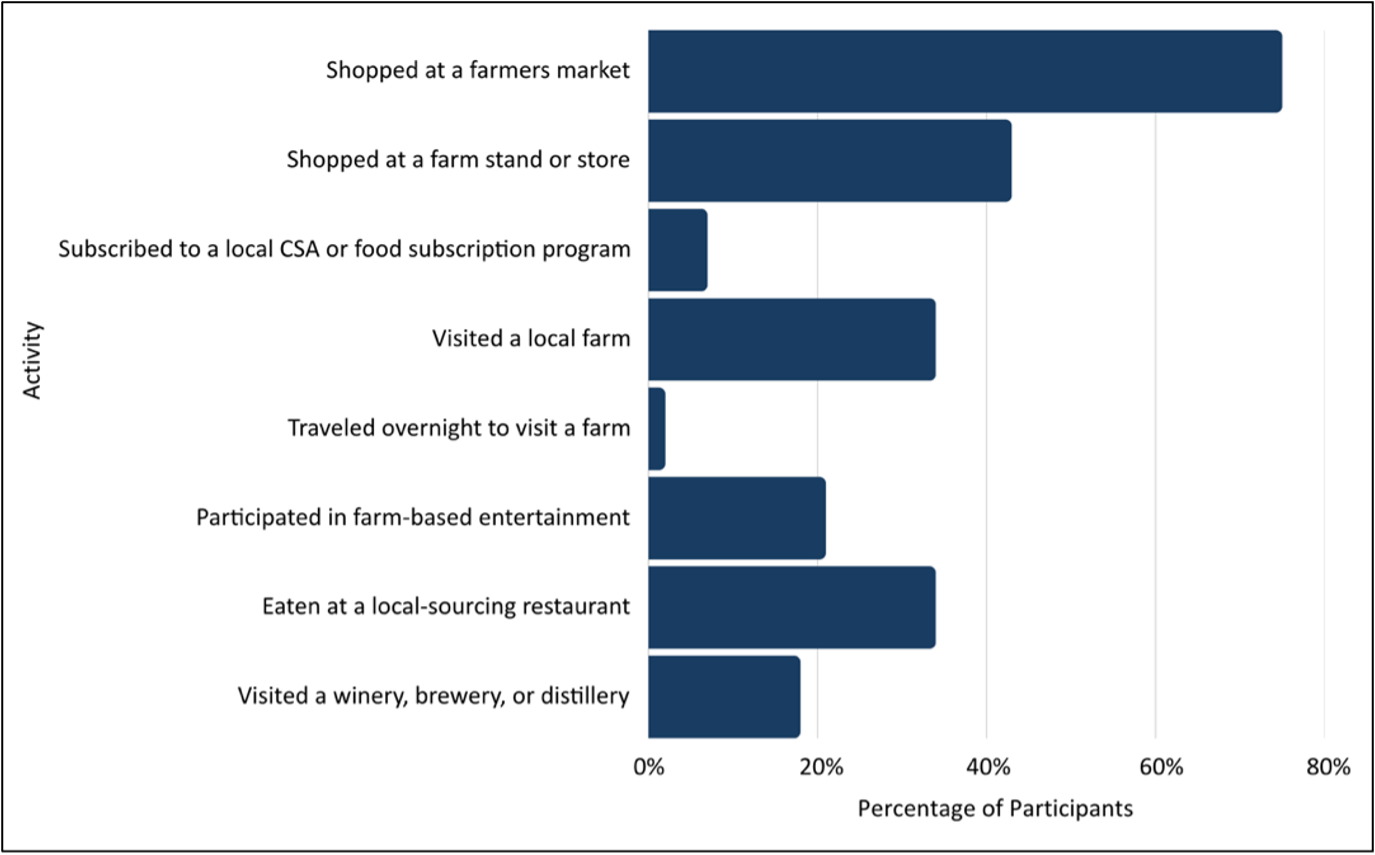
When asked about their participation in food- and farm-related activities over the past year, three-quarters (75%) of the participants reported shopping at farmers markets, and 43% shopped at farm stands or stores (see Figure 2). In contrast, only 2% of participants traveled overnight to visit a farm; thus, it was the least common activity. Additionally, 34% reported visiting farms in general over the past year.
Figure 2. Participation in Food- and Farm-Related Activities
Conclusions
Study findings show that price, taste, and freshness were the top three factors in consumer fruit-buying decisions. Nearly all the study participants had purchased or consumed strawberries in the past three months, and after apples and bananas, strawberries were their most commonly consumed fruit. One-third of participants consumed strawberries several times a month and commonly purchased them at grocery stores. Locally grown strawberries were valued over organic and other specialty labels, suggesting a market opportunity for Utah farmers who can leverage season-extension technologies to meet demand.
Consumer food behaviors highlighted a preference for fresh, safe foods, with most participants engaging in physical activity and avoiding processed foods. As a large portion of participants visited farmers markets as well as farms stands and stores, farmers markets and other direct-to-consumer channels may be effective outlets for marketing strawberries, particularly if “fresh” and “locally grown” are emphasized. Understanding these preferences can help Utah strawberry growers refine their production, marketing, and pricing strategies to maximize profitability.
Acknowledgments
This material is based upon work supported by the National Institute of Food and Agriculture and the U.S. Department of Agriculture (USDA), award number 2020-38640-31523 through the Western Sustainable Agriculture Research and Education program under project number SW21-923. The USDA is an equal opportunity employer and service provider. Any opinions, findings, conclusions, or recommendations expressed in this publication are those of the author(s) and do not necessarily reflect the view of the USDA.
References
- Booker, C. (2023). As Utah urbanizes, fruit fests celebrate heritage rather than what’s grown here. On Point, KUER, National Public Radio (NPR). https://www.kuer.org/arts-culture-entertainment/2023-06-09/as-utah-urbanizes-fruit-fests-celebrate-heritage-rather-than-whats-grown-here
- Maughan, T., Curtis, K., Black, B., & Drost, D. (2015). Economic evaluation of implementing strawberry season extension production technologies in the U.S. Intermountain West. HortScience, 50(3), 395-401.
- Rowley, C., Black, B., & Drost, D. (2010). High tunnel strawberry production [Fact sheet]. Utah State University Extension.

June 2025
Utah State University Extension
Peer-reviewed fact sheet
Authors
Makaylie Langford, Research Assistant, Department of Applied Economics
Kynda Curtis, Professor and USU Extension Specialist, Department of Applied Economics

Kynda Curtis
Food Systems Specialist
APEC Dept