
How Can I Tell if Eggs Have Gone Bad?
Quick Answer
You can tell if eggs may be bad by checking for an unusual smell or appearance when you crack them open. However, harmful bacteria may be present even when an egg looks and smells normal. To lower your risk of foodborne illness, store eggs properly, check how long they have been stored, and throw away any eggs that show signs of spoilage.
Does the Egg Float Test Prove an Egg Is Safe to Eat?
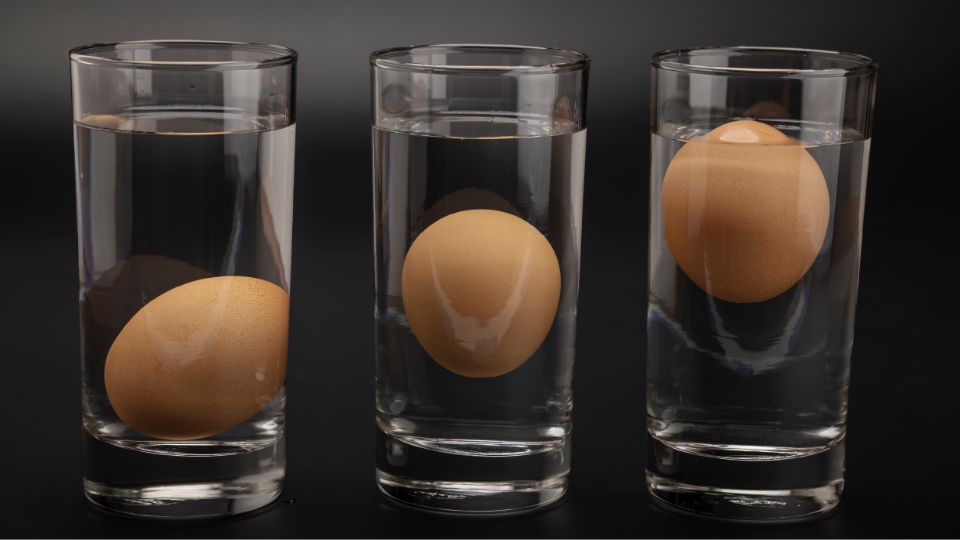
No. The egg float test can help you estimate an egg's age, but it cannot tell you whether the egg is safe to eat. As an egg gets older, the air pocket inside it grows larger. This changes how the egg floats in water.
Here is what the results may mean:
- Sinks and lies flat: The egg is likely fresh.
- Sinks but stands upright: The egg is older but may still be safe to eat.
- Floats to the surface: The egg is older, but floating alone does not prove it is spoiled.
The float test only helps estimate an egg's age. It cannot detect harmful bacteria, such as Salmonella, that may cause foodborne illness. If you are unsure whether an egg is safe, crack it into a separate bowl and check for an unusual smell or appearance. However, an egg that looks and smells normal is not guaranteed to be safe.
How Long Do Eggs Last in the Fridge?
Fresh, raw eggs can last 3 to 5 weeks in the refrigerator when stored at 40°F or below. However, their quality may decrease over time.
For the best storage:
- Keep eggs in their original carton.
- Store them on a shelf inside the refrigerator, not in the door.
- Keep the refrigerator at 40°F or below.
- Do not leave refrigerated eggs at room temperature for more than 2 hours.
Eggs may still be usable after the date printed on the carton if they have been stored properly. However, older eggs may not work as well in some recipes.
Hard-boiled eggs should be eaten within 1 week when stored in the refrigerator. Hard-boiled eggs, whether peeled or still in their shells, should not be left out of the refrigerator for more than 2 hours. If the temperature is above 90°F, such as at a hot summer picnic, that limit drops to 1 hour. The same time limits apply to both peeled and unpeeled hard-boiled eggs. The shell does not make a cooked egg safe to leave at room temperature longer.
Do Farm-Fresh Unwashed Eggs Need to be Refrigerated?
Refrigeration is the safest way to store farm-fresh eggs, even if they have not been washed. Freshly laid eggs have a thin protective coating on their shells called the bloom, or cuticle. This coating helps keep bacteria from entering through the shell. Washing eggs can remove this protective layer.
However, unwashed eggs are not free from bacteria. Salmonella, a type of bacteria that can cause food poisoning, may be present inside an egg before it is laid. For safe storage, place farm-fresh eggs in the refrigerator at 40°F or below as soon as possible after collecting them. Keep them in a carton on an inside shelf. Even though the natural coating helps protect unwashed eggs, refrigeration provides better protection for both safety and quality.
References
- USU Extension — Storing Eggs Safely
- USU Extension — A Farmer's Guide to Egg Quality, Safety, and Flock Health
- UK Extension — COMMON QUESTIONS ABOUT EGGS
Adapted from USU Extension food safety resources.
Contact
Jose Brandao, USU Extension Food Safety Specialist

Jose Brandao
Assistant Professor | Extension Food Safety Specialist
Nutrition, Dietetics, and Food Sciences