
How Can I Identify a Queen Bee?
Quick Answer
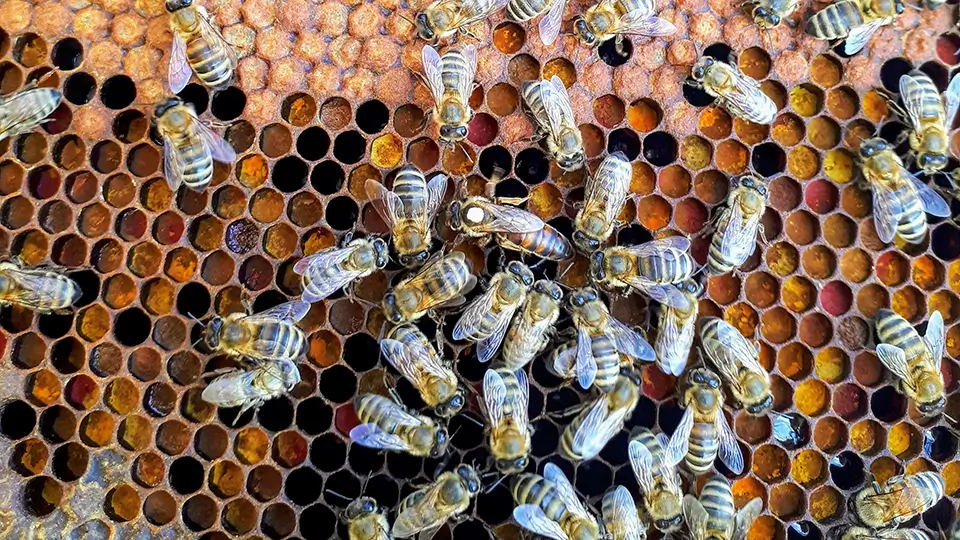
To identify a queen bee, look for the bee with a long, tapered abdomen that reaches past her folded wings. Her back has a smooth, often darker shield with less hair than a worker bee. She is longer than the other bees, but her narrow shape can make her easy to miss.
What Does a Queen Bee Look Like?
A honey bee colony has one queen, many female workers, and male drones. The queen is built to lay eggs, so her body looks different from the others.
- Long abdomen: Her abdomen is long and tapered. It often reaches well past the tips of her folded wings.
- Smooth back: The shield on top of her thorax, the middle part of her body, has less hair and may look dark and shiny.
- Longer body: She is longer than workers and drones, though a drone may look wide or bulky.
- No pollen baskets: The queen does not gather pollen, so you will not see full pollen baskets on her back legs.
Color alone is not a good guide. A queen may be golden, brown, or very dark. Look at her shape first.
How Is a Queen Different From a Worker or Drone?
- Queen: Long, tapered abdomen; smooth thorax; one in a healthy colony.
- Worker: Shorter and smaller; most bees in the hive are workers.
- Drone: Wider and more rounded than a worker; drones are males and do not lay eggs.
Do not choose the widest bee and assume it is the queen. Look for length, especially the abdomen that extends beyond the wings.
Where Should I Look for the Queen?
Start in the brood nest, where the colony is raising young bees. The queen is often on a frame with eggs or young larvae because she moves from cell to cell to lay eggs. In a hive with two brood boxes, she may be in either box.
Spring can be a good time to practice. Colony numbers are smaller in spring, so the queen may be easier to spot. She can be much harder to find when the hive is full of bees in summer.
How Can I Find the Queen More Easily?
- Open the hive on a warm, calm day and work slowly.
- Remove an outside frame to make room. Keep every frame over the open hive while you look.
- Move toward frames with eggs, larvae, and capped brood.
- Scan one side of each frame from top to bottom, then turn it and check the other side.
- Look for the queen's long abdomen and smooth back. Watch for a bee moving from cell to cell.
- If you find her, gently return that frame to the hive before doing more work.
A marked queen may have a small colored dot on her thorax. The dot can help, but not every queen is marked and a mark can wear off. Learn her body shape so you can find her with or without a mark.
What if I Cannot Find the Queen?
Do not decide that the hive is queenless just because you did not see her. A busy colony can hide one queen among thousands of bees. Instead, look for fresh eggs and very young larvae. These signs show that a queen was laying in the hive recently.
Learn what those early stages look like in What Is Bee Brood?. Then use How Can I Tell if My Queen Is Healthy? to judge her work by the brood pattern, colony growth, and behavior.
Is a Queen Cell the Queen?
No. A queen cell is the wax cell where bees raise a new queen. It is long, shaped like a peanut, and hangs down from the comb. An adult queen is the live bee walking on the frame.
Finding queen cells can mean the colony is replacing its queen or getting ready to swarm. Note where the cells are and whether they hold an egg, larva, or pupa. Do not remove them until you understand what is happening in the hive.
Use Queen Identification During Hive Inspections
You do not need to see the queen during every visit. Her eggs, young brood, and laying pattern often tell you more about colony health. Use What Should I Look for When Inspecting My Beehive? and How Often Should I Inspect My Beehive? to plan a careful check.
References
- USU Extension Splitting a Beehive
- USU Extension Beekeeping Annual Calendar
- USU Extension Honey Bee Biology
Adapted from USU Extension beekeeping and honey bee biology resources.
Authors

Andreé Walker Bravo
Director of County Operations
Agriculture and Natural Resources