Why do we care about the Specific Conductance of our streams?
The specific conductance of water is related to how many salts are dissolved in the water. The saltiness of water controls many cell functions in aquatic plants and animals. Irrigation water that is too salty may damage agricultural crops, or cause crusting of soils. Salts in water also affect other chemical reactions such as the corrosion of metals.
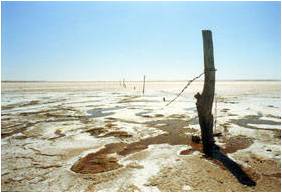
Nothing can grow on land when salt builds up in the soil.
How do human activities affect the Specific Conductance in water?
As water drains through soils it dissolves salts and minerals, which increases the specific conductance. River water that is diverted for irrigation may go through this process multiple times as it drains back to the river and is diverted again downstream.
Evaporation from reservoirs removes water but not salts, so this process can further increase the water’s conductance. “Product water” from gas wells can be very salty and may find its way into natural rivers. Other municipal and industrial uses may also introduce salts to water.
Improved irrigation practices and better management of natural gas mines’ product water can protect rivers from salt pollution.